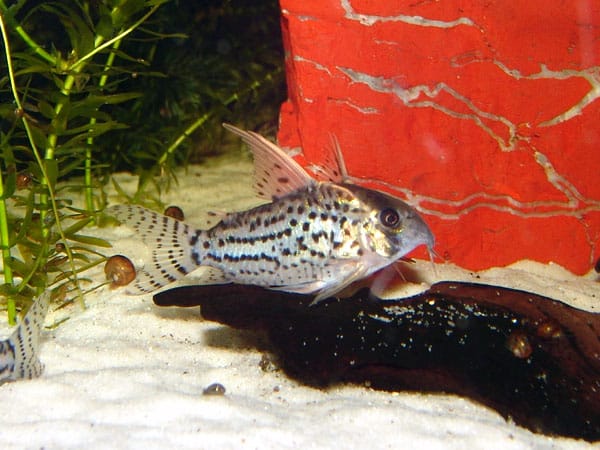
Schwartz's catfish
Corydoras schwartzi
Parameter dashboard
22-24 °C
6-7.5
7 cm
5 years
Care guide
Corydoras schwartzi, commonly referred to as Schwartz’s Cory or Schwartz’s Catfish, is a peaceful armoured catfish endemic to the Rio Purus drainage in Brazil. It reaches a maximum size of approximately 7 cm and should be maintained in groups of at least six individuals in a tank measuring 60 × 37.5 cm or larger. A soft sand substrate is essential for protecting the barbels, and the aquarium can be decorated with driftwood, twisted roots, and dried leaves to replicate a South American blackwater biotope. Water conditions should be soft and slightly acidic to neutral, with a temperature of 22–24 °C, pH of 6.0–7.5, and hardness of 1–15 °H. Dim lighting and the addition of aquarium-safe peat in the filter further simulate natural conditions, making the fish more confident and active. Schwartz’s Cory is omnivorous and readily accepts high-quality sinking pellets or tablets as a staple, supplemented with live and frozen foods such as Daphnia, Artemia, and bloodworm. It is a very peaceful species suitable for community tanks with small characins, cyprinids, anabantoids, and dwarf cichlids. As with all Corydoras species, never keep it with large or aggressive tankmates. Females are noticeably rounder and broader-bodied than males when viewed from above. Breeding this species can be challenging, requiring cool water changes with increased oxygenation to trigger spawning, with eggs typically deposited on aquarium glass or plant leaves.
Sources
- seriouslyfish.com — https://www.seriouslyfish.com/species/corydoras-schwartzi/
- fishbase.se — https://www.fishbase.se/summary/Corydoras-schwartzi.html
Further reading on identification and aquarium care.
Tankmate compatibility (sample)
Pairwise screening against other species in the database (prioritizing the same family when data is available).
Review first (4)
Caution or avoid from automated rules — confirm before mixing.
| Species | Assessment | Notes |
|---|---|---|
| Hoplo Catfish Megalechis thoracata Caution | Caution | Fish 2x+ larger may eat smaller tankmates · close relatives, and one of them is territorial, so both claim the same kind of space · one is boisterous and the other a much smaller peaceful fish sharing the same floor, where it can be intimidated and outcompeted at feeding time Open pair in Compare → |
| Pygmy corydoras Corydoras pygmaeus Caution | Caution | Fish 2x+ larger may eat smaller tankmates Open pair in Compare → |
| Palespotted corydoras Hoplisoma gossei Avoid | Avoid | Species with non-overlapping temperature ranges cannot coexist · the two share only a narrow band of temperature, so one of them sits at the edge of its range Open pair in Compare → |
| Sterba's cory Corydoras sterbai Avoid | Avoid | Species with non-overlapping temperature ranges cannot coexist · the two share only a narrow band of temperature, so one of them sits at the edge of its range Open pair in Compare → |
6 species with compatible assessment in this sampleCollapse to hide the list; use “Open pair in Compare” for the full matrix.
| Species | Assessment | Notes |
|---|---|---|
| Adolf's catfish Corydoras adolfoi Compatible | Compatible | No rule-based conflicts detected for this pair. Open pair in Compare → |
| Bronze corydoras Osteogaster aenea Compatible | Compatible | No rule-based conflicts detected for this pair. Open pair in Compare → |
| Leopard corydoras Corydoras julii Compatible | Compatible | No rule-based conflicts detected for this pair. Open pair in Compare → |
| Panda corydoras Corydoras panda Compatible | Compatible | No rule-based conflicts detected for this pair. Open pair in Compare → |
| Peppered corydoras Hoplisoma paleatum Compatible | Compatible | No rule-based conflicts detected for this pair. Open pair in Compare → |
| Twosaddle corydoras Hoplisoma weitzmani Compatible | Compatible | No rule-based conflicts detected for this pair. Open pair in Compare → |
Same rule engine as Compare. Not a substitute for observation, tank size, or acclimation.
Related species
Was this page useful? Spot anything wrong?