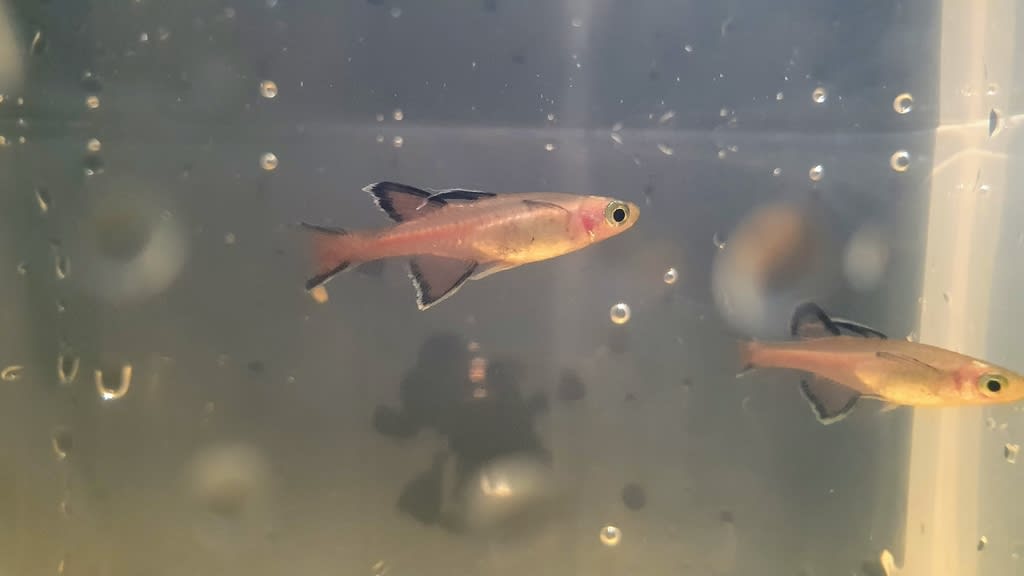
Honey blue eye
Pseudomugil mellis
Parameter dashboard
24-28 °C
6-7.5
3.5 cm
Care guide
The honey blue-eye is a small, delicate rainbowfish endemic to the Wallum heathland of southeastern Queensland, Australia, where it inhabits slow-moving, tannin-stained coastal creeks and dune lakes with soft, acidic water. Reaching about 3.5 cm standard length, males are exquisitely coloured: a warm honey-bronze body with brilliant blue eyes, a first dorsal fin that is predominantly black with a white anterior border, and anal and second dorsal fins edged in a thin black submarginal band with a white margin. Obtain captive stocks with a documented origin. Leaf litter can provide cover and a blackwater-style setting; check the actual water chemistry rather than assuming that adding leaves establishes the desired pH. For aquarium care, use a stable temperature of 24–28°C and soft water. Keep water at pH 6.0–7.5. They are sensitive to poor water quality and require stable, mature conditions. A tight-fitting lid is essential as these are accomplished jumpers, and strong water currents must be avoided — a simple air-driven sponge filter is ideal.
These are peaceful, shy group fish. Keep a group with room for fish to retreat from displaying males. Males display their fins and breed within territories; provide plants and room for other fish to retreat rather than assuming that all displays are harmless. They are omnivorous but require small foods: high-quality micro-pellets, crushed flake, and live or frozen brine shrimp, daphnia, and micro-worms. Compatible tankmates include other small, peaceful nano fish like dwarf rasboras, small tetras, and shrimp. Avoid all aggressive or boisterous species. Breeding is relatively straightforward: spawning occurs over several days on Java moss or spawning mops, and eggs can hatch within about nine days at the warmer end of the range described by Aquatic Community. Separate eggs from adults, start newly hatched fry on very small foods, and move to Artemia only when the fry can take them.
Sources
- aquaticcommunity.com — https://www.aquaticcommunity.com/blue-eye/honey.php
- fishbase.se — https://www.fishbase.se/summary/Pseudomugil-mellis.html
Further reading on identification and aquarium care.
Tankmate compatibility (sample)
Pairwise screening against other species in the database (prioritizing the same family when data is available).
Review first (6)
Caution or avoid from automated rules — confirm before mixing.
| Species | Assessment | Notes |
|---|---|---|
| Assassin Snail Anentome helena Caution | Caution | Species with non-overlapping pH ranges may not thrive together Open pair in Compare → |
| Blue gularis Fundulopanchax sjostedti Caution | Caution | Fish 2x+ larger may eat smaller tankmates Open pair in Compare → |
| Chessboard cichlid Dicrossus filamentosus Caution | Caution | Fish 2x+ larger may eat smaller tankmates · the two share only a narrow band of temperature, so one of them sits at the edge of its range Open pair in Compare → |
| Coolie loach Pangio semicincta Caution | Caution | Fish 2x+ larger may eat smaller tankmates Open pair in Compare → |
| Guayas cichlid Cichlasoma festae Caution | Caution | Fish 2x+ larger may eat smaller tankmates Open pair in Compare → |
| Small snakehead Channa asiatica Caution | Caution | Fish 2x+ larger may eat smaller tankmates · the two share only a narrow band of temperature, so one of them sits at the edge of its range Open pair in Compare → |
6 species with compatible assessment in this sampleCollapse to hide the list; use “Open pair in Compare” for the full matrix.
| Species | Assessment | Notes |
|---|---|---|
| Alien betta Betta splendens hybrid Compatible | Compatible | No rule-based conflicts detected for this pair. Open pair in Compare → |
| Forktail rainbowfish Pseudomugil furcatus Compatible | Compatible | No rule-based conflicts detected for this pair. Open pair in Compare → |
| Honey gourami Trichogaster chuna Compatible | Compatible | No rule-based conflicts detected for this pair. Open pair in Compare → |
| Spotted blue-eye Pseudomugil gertrudae Compatible | Compatible | No rule-based conflicts detected for this pair. Open pair in Compare → |
| Strawberry Rasbora Boraras naevus Compatible | Compatible | No rule-based conflicts detected for this pair. Open pair in Compare → |
| White Seam Betta Betta albimarginata Compatible | Compatible | No rule-based conflicts detected for this pair. Open pair in Compare → |
Same rule engine as Compare. Not a substitute for observation, tank size, or acclimation.
Related species
Was this page useful? Spot anything wrong?