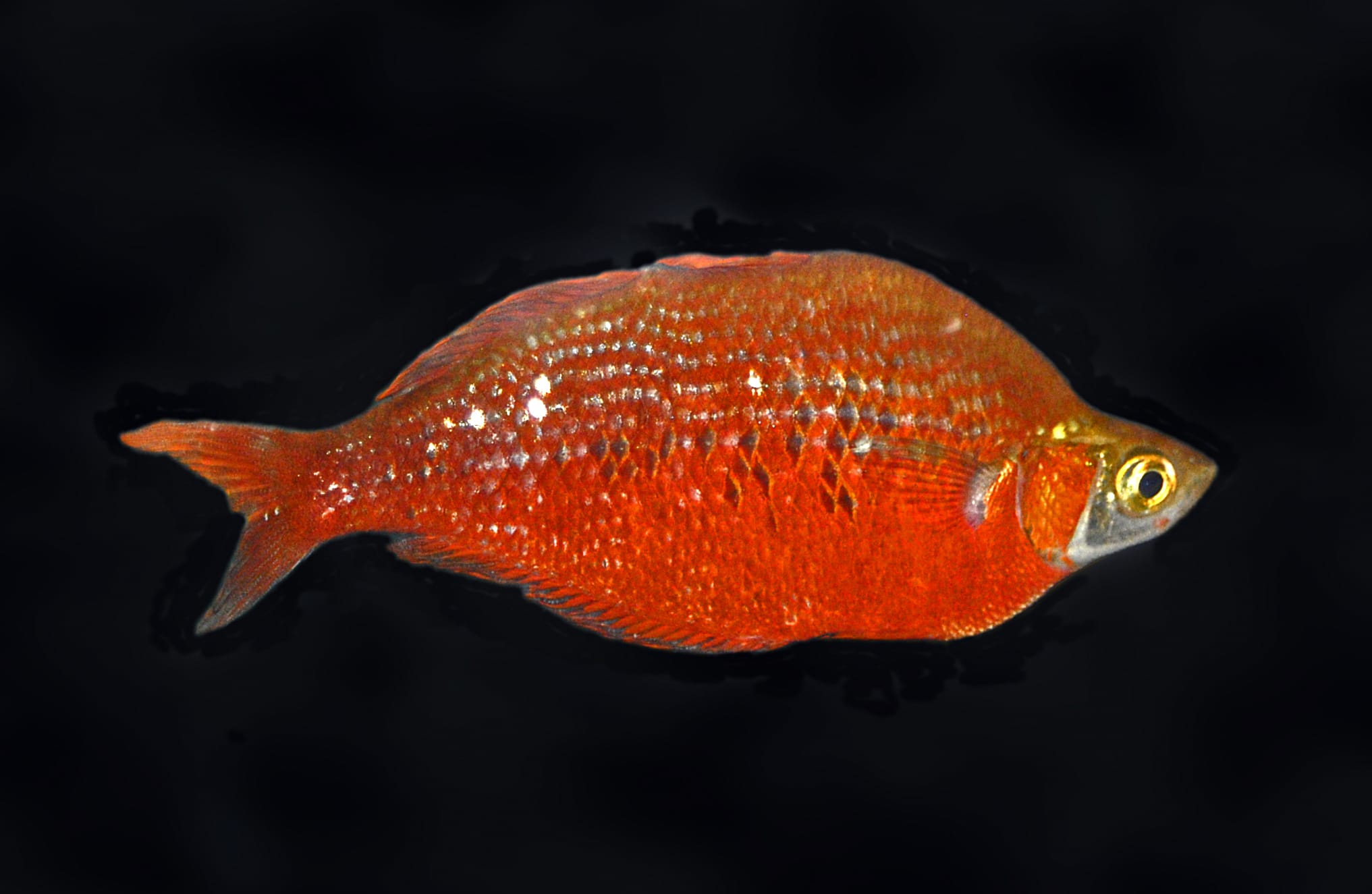
Red rainbowfish
Glossolepis incisus
Parameter dashboard
22.2-25 °C
7-8
15 cm
6 years
Care guide
The red rainbowfish (Glossolepis incisus), also known as the salmon-red or New Guinea rainbowfish, is a strikingly coloured freshwater species endemic to Lake Sentani and its tributaries near Jayapura in Papua, Indonesia. Males develop a brilliant red body and a distinctive high-backed profile as they mature, while females and subordinate males remain olive-brown. Reaching up to 15 cm (6 in) in the wild, though typically 12 cm in aquaria, these active midwater swimmers bring vibrant movement to any community tank. The species is classified as Endangered in its native range due to habitat pressure from human population growth and introduced species such as tilapia, though it is readily bred in captivity and widely available in the trade.
Red rainbowfish are very peaceful by nature but their rapid movements and active swimming can disturb smaller or slow-moving tankmates, so they are best housed with similarly sized rainbowfish, characins, danios, barbs, or Corydoras catfish. They are strongly schooling and should be kept in groups of at least six to eight, which encourages males to display their best colouration. Provide a tank at least 120 cm long, with planting along the sides and open swimming corridors. Water movement should be gentle.
Water parameters should be maintained at 22-25C (72-77F), pH 7.0-8.0, with moderate to hard water (10-20 dH); they will not thrive in soft, acidic conditions. They accept most dried, frozen, and live foods readily, with regular feedings of live or frozen options enhancing colouration. Breeding is straightforward: the pair scatter eggs among fine-leaved plants or spawning mops over several weeks, and the eggs hatch in 7-8 days. Aquarium lifespan estimates are around 6 years with suitable care.
Sources
- seriouslyfish.com — https://www.seriouslyfish.com/species/glossolepis-incisus/
- en.wikipedia.org — https://en.wikipedia.org/wiki/Red_rainbowfish
Further reading on identification and aquarium care.
Tankmate compatibility (sample)
Pairwise screening against other species in the database (prioritizing the same family when data is available).
Review first (9)
Caution or avoid from automated rules — confirm before mixing.
| Species | Assessment | Notes |
|---|---|---|
| Assassin Snail Anentome helena Caution | Caution | Fish 2x+ larger may eat smaller tankmates Open pair in Compare → |
| Borneo Loach Pangio shelfordii Caution | Caution | Species with non-overlapping pH ranges may not thrive together Open pair in Compare → |
| Gold Cap Caudopunctatus Neolamprologus caudopunctatus Caution | Caution | Fish 2x+ larger may eat smaller tankmates Open pair in Compare → |
| Guppy Poecilia reticulata Caution | Caution | Fish 2x+ larger may eat smaller tankmates Open pair in Compare → |
| Jewel tetra Hyphessobrycon eques Caution | Caution | Fish 2x+ larger may eat smaller tankmates Open pair in Compare → |
| Mendezs Dwarf Cichlid Apistogramma mendezi Caution | Caution | Fish 2x+ larger may eat smaller tankmates · Species with non-overlapping pH ranges may not thrive together Open pair in Compare → |
| Orange Fin Danio Danio kyathit Caution | Caution | Fish 2x+ larger may eat smaller tankmates Open pair in Compare → |
| Threadfin rainbowfish Iriatherina werneri Caution | Caution | Fish 2x+ larger may eat smaller tankmates Open pair in Compare → |
| Boeseman's rainbowfish Melanotaenia boesemani Avoid | Avoid | Species with non-overlapping temperature ranges cannot coexist · the two share only a narrow band of temperature, so one of them sits at the edge of its range Open pair in Compare → |
3 species with compatible assessment in this sampleCollapse to hide the list; use “Open pair in Compare” for the full matrix.
| Species | Assessment | Notes |
|---|---|---|
| Blue gularis Fundulopanchax sjostedti Compatible | Compatible | No rule-based conflicts detected for this pair. Open pair in Compare → |
| Dwarf rainbowfish Melanotaenia praecox Compatible | Compatible | No rule-based conflicts detected for this pair. Open pair in Compare → |
| Moga Hypsophrys nicaraguensis Compatible | Compatible | No rule-based conflicts detected for this pair. Open pair in Compare → |
Same rule engine as Compare. Not a substitute for observation, tank size, or acclimation.
Related species
Was this page useful? Spot anything wrong?