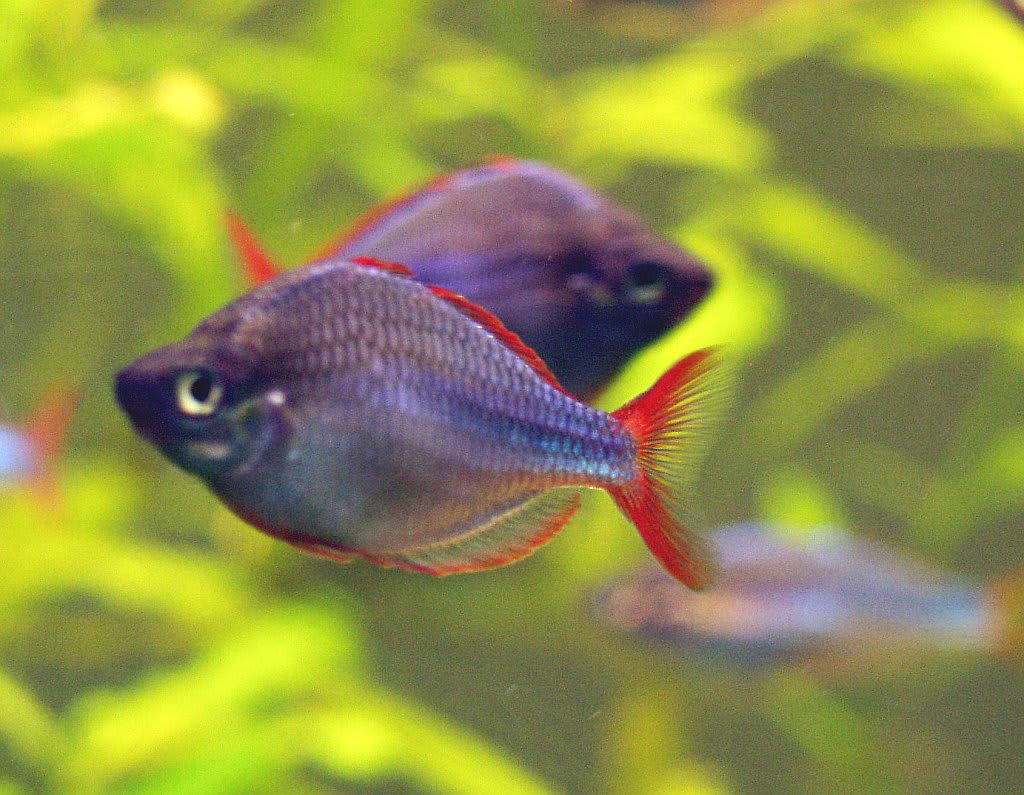
Dwarf rainbowfish
Melanotaenia praecox
Parameter dashboard
23-28 °C
6.8-7.5
8 cm
5 years
Care guide
The dwarf rainbowfish (Melanotaenia praecox), also called the neon dwarf rainbowfish, is a small, brilliantly coloured species endemic to the Mamberamo River system in Papua, Indonesia. Males reach about 8 cm (3.2 in) and develop an iridescent neon blue body with bright red-orange fins and a deep, compressed body profile, while females remain smaller, silverer, and less intensely coloured. They are active midwater swimmers that bring constant motion and colour to a planted community tank.
Provide a base of at least 60 × 30 cm, with planting along the sides and open swimming space. Floating plants help diffuse lighting, which encourages the fish to stay active and display their best colours. High water quality is essential, with weekly partial water changes. Temperature should be 23-28C (73-82F), pH 6.8-7.5, with moderate hardness of 5-15 dH. They are unfussy omnivores and accept most dried, frozen, and live foods.
Dwarf rainbowfish are very peaceful but can be skittish, so they must be kept in groups of at least six to eight, ideally more. Males display constantly to one another, which encourages the best colouration without serious aggression. Suitable tankmates include other small rainbowfish, characins, danios, barbs, dwarf cichlids, and Corydoras catfish. Breeding is straightforward: the pair scatter eggs among fine-leaved plants or spawning mops over several weeks, with the eggs hatching in 7-8 days. Aquarium lifespan estimates are around 5 years with suitable care.
Sources
- en.wikipedia.org — https://en.wikipedia.org/wiki/Melanotaenia_praecox
- seriouslyfish.com — https://www.seriouslyfish.com/species/melanotaenia-praecox/
Further reading on identification and aquarium care.
Tankmate compatibility (sample)
Pairwise screening against other species in the database (prioritizing the same family when data is available).
Review first (7)
Caution or avoid from automated rules — confirm before mixing.
| Species | Assessment | Notes |
|---|---|---|
| Blue-eye panaque Panaque suttonorum Caution | Caution | Fish 2x+ larger may eat smaller tankmates · the two share only a narrow band of temperature, so one of them sits at the edge of its range Open pair in Compare → |
| Boeseman's rainbowfish Melanotaenia boesemani Caution | Caution | the two share only a narrow band of temperature, so one of them sits at the edge of its range Open pair in Compare → |
| Diamond tetra Moenkhausia pittieri Caution | Caution | Species with non-overlapping pH ranges may not thrive together Open pair in Compare → |
| Malabar pufferfish Carinotetraodon travancoricus Caution | Caution | Fish 2x+ larger may eat smaller tankmates Open pair in Compare → |
| Pictus cat Pimelodus pictus Caution | Caution | Species with non-overlapping pH ranges may not thrive together Open pair in Compare → |
| Silver Tiger fish Datnioides polota Caution | Caution | Fish 2x+ larger may eat smaller tankmates · Species with non-overlapping pH ranges may not thrive together Open pair in Compare → |
| Threadfin rainbowfish Iriatherina werneri Caution | Caution | Fish 2x+ larger may eat smaller tankmates Open pair in Compare → |
5 species with compatible assessment in this sampleCollapse to hide the list; use “Open pair in Compare” for the full matrix.
| Species | Assessment | Notes |
|---|---|---|
| Colombian Tetra Hyphessobrycon columbianus Compatible | Compatible | No rule-based conflicts detected for this pair. Open pair in Compare → |
| Convict cichlid Amatitlania nigrofasciata Compatible | Compatible | No rule-based conflicts detected for this pair. Open pair in Compare → |
| Red rainbowfish Glossolepis incisus Compatible | Compatible | No rule-based conflicts detected for this pair. Open pair in Compare → |
| Silvertip tetra Hasemania nana Compatible | Compatible | No rule-based conflicts detected for this pair. Open pair in Compare → |
| Zebra pleco Hypancistrus zebra Compatible | Compatible | No rule-based conflicts detected for this pair. Open pair in Compare → |
Same rule engine as Compare. Not a substitute for observation, tank size, or acclimation.
Related species
Was this page useful? Spot anything wrong?