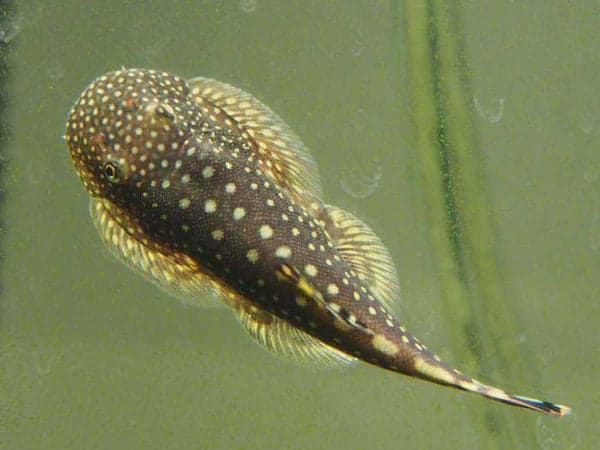
Borneo Loach
Pangio shelfordii
Parameter dashboard
21-26 °C
4-7
8 cm
Care guide
Buy this loach and you may not see it for a week. Pangio shelfordii spends much of its day buried in the substrate, which is why sand matters more here than almost anything else in the tank: coarse gravel can impede burrowing and carries a risk of injury. It reaches a standard length of 8 cm, and a footprint of 60 by 30 centimetres, working out at 54 litres, is enough for a group.
Wild fish live in slow forest streams, swamps and oxbows across Peninsular Malaysia, Singapore, Sumatra and Borneo, much of it peat-stained blackwater with readings as low as 3.0 or 4.0 on the acid scale. That tolerance shows in the published aquarium figures of pH 4.0-7.0 and 21-26 °C, far wider on the acid side than most community fish accept. FishBase publishes a warmer 24-30 °C band and a narrower pH window of 5.5 to 6.5.
Buy at least five. They are peaceful with everything, including each other, and in nature they gather in large aggregations, while a lone specimen tends to stay hidden permanently. Feed sinking dried food plus frozen or live bloodworm, daphnia and artemia, because the natural diet is mostly insect larvae and small crustaceans sifted out of the substrate. Leaf litter, driftwood and dim lighting complete the picture, and a tight cover is worth having, since most loaches jump when first moved. Protect filter intakes so that small fish cannot enter them.
Sources
- seriouslyfish.com — https://www.seriouslyfish.com/species/pangio-shelfordii/
- fishbase.us — https://www.fishbase.us/summary/Pangio-shelfordii.html
Further reading on identification and aquarium care.
Tankmate compatibility (sample)
Pairwise screening against other species in the database (prioritizing the same family when data is available).
Review first (6)
Caution or avoid from automated rules — confirm before mixing.
| Species | Assessment | Notes |
|---|---|---|
| Assamese snakehead Channa stewartii Caution | Caution | Fish 2x+ larger may eat smaller tankmates Open pair in Compare → |
| Galaxy betta Betta splendens Caution | Caution | one of these species is highly aggressive and is usually best kept on its own Open pair in Compare → |
| Livingstonii Cichlid Nimbochromis livingstonii Caution | Caution | Fish 2x+ larger may eat smaller tankmates · Species with non-overlapping pH ranges may not thrive together Open pair in Compare → |
| Pond loach Misgurnus anguillicaudatus Caution | Caution | Fish 2x+ larger may eat smaller tankmates Open pair in Compare → |
| Royal Farlowella Sturisomatichthys festivus Caution | Caution | Fish 2x+ larger may eat smaller tankmates · one is boisterous and the other a much smaller peaceful fish sharing the same floor, where it can be intimidated and outcompeted at feeding time Open pair in Compare → |
| Zebra Archerfish Toxotes blythii Caution | Caution | the two share only a narrow band of temperature, so one of them sits at the edge of its range Open pair in Compare → |
6 species with compatible assessment in this sampleCollapse to hide the list; use “Open pair in Compare” for the full matrix.
| Species | Assessment | Notes |
|---|---|---|
| Buenos Aires tetra Hyphessobrycon anisitsi Compatible | Compatible | No rule-based conflicts detected for this pair. Open pair in Compare → |
| Coolie loach Pangio semicincta Compatible | Compatible | No rule-based conflicts detected for this pair. Open pair in Compare → |
| Giant kuhli loach Pangio myersi Compatible | Compatible | No rule-based conflicts detected for this pair. Open pair in Compare → |
| Lizard Loach Homaloptera orthogoniata Compatible | Compatible | No rule-based conflicts detected for this pair. Open pair in Compare → |
| Panda Garra Garra flavatra Compatible | Compatible | No rule-based conflicts detected for this pair. Open pair in Compare → |
| Zebra Oto Otocinclus cocama Compatible | Compatible | No rule-based conflicts detected for this pair. Open pair in Compare → |
Same rule engine as Compare. Not a substitute for observation, tank size, or acclimation.
Related species
Was this page useful? Spot anything wrong?