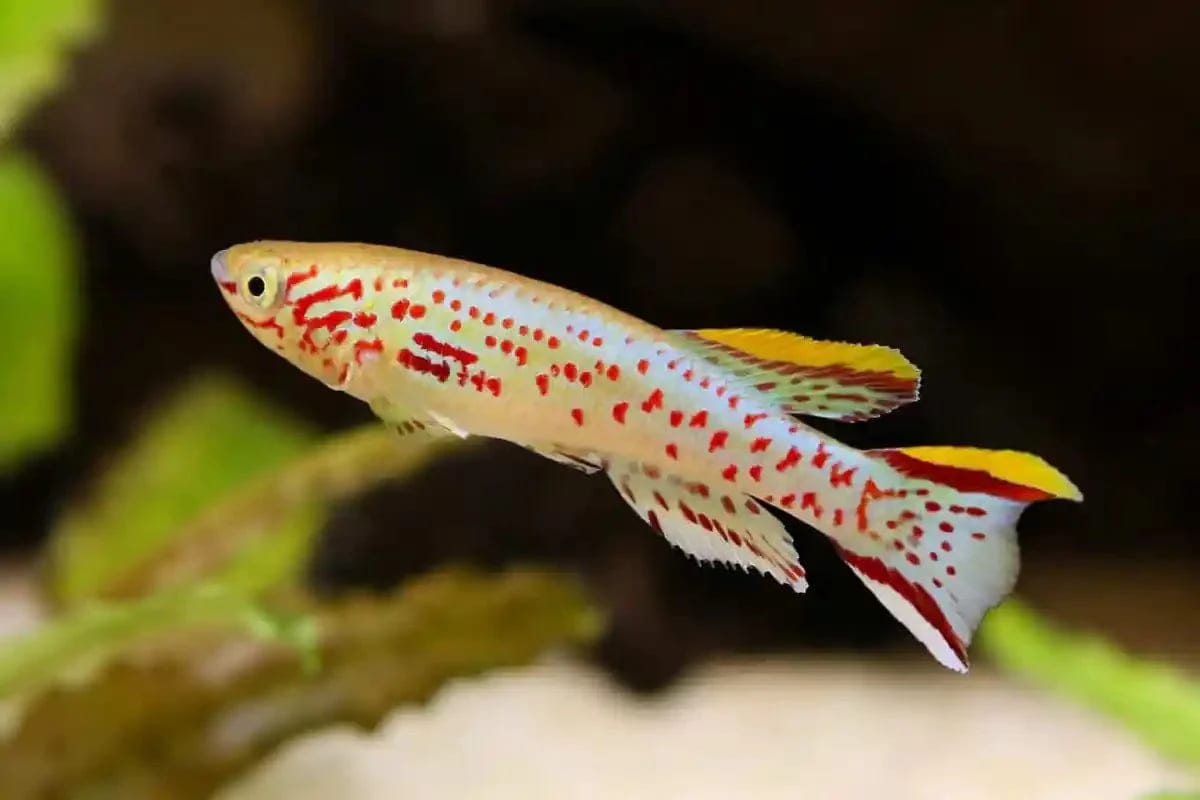
Blue lyretail
Fundulopanchax gardneri
Parameter dashboard
20-26 °C
6-7.5
5.5 cm
3 years
Care guide
Gardner's killifish is a small West African toothcarp from the Cross River and Benue drainages of Nigeria and Cameroon. In the wild it lives in shallow, soft, acidic water — brooks, swamps and forest pools that are sometimes only a few centimetres deep and, in places, dry down seasonally. It is sold in the trade as the blue lyretail, and most aquarium stock descends from hardy line-bred strains.
A mature male is the reason people keep the fish: a sky-blue body flecked with red, fins edged in yellow, and a tail drawn out into the lyre shape that gives it its common name. Females are plain tan by comparison. Males reach around 5.5 cm and stay a little larger than females.
It is not suited to a general community, although carefully chosen robust companions are possible. Males spar with one another and harass females, so the usual approach is one male to two or three females in a well-planted tank, with plenty of broken sightlines. Keep the water soft and tannin-stained — a sponge filter, dark substrate and some leaf litter suit it — at 20–26 °C and a pH of 6.0–7.5. A tight lid is not optional; these fish jump.
Provide a varied micropredator diet. It is a micropredator that takes small live and frozen fare such as daphnia, brine shrimp and bloodworm, and usually accepts suitable dried food, with regular live or frozen meals. That same appetite makes it unsafe with dwarf shrimp, which it will hunt. For breeding, a conditioned pair lays a few eggs a day among fine plants or a spawning mop, and the eggs hatch in roughly two to three weeks.
Provide an aquarium at least 60 cm long.
Sources
- seriouslyfish.com — https://www.seriouslyfish.com/species/fundulopanchax-gardneri-gardneri/
- fishbase.se — https://www.fishbase.se/summary/Fundulopanchax-gardneri.html
Further reading on identification and aquarium care.
Tankmate compatibility (sample)
Pairwise screening against other species in the database (prioritizing the same family when data is available).
Review first (4)
Caution or avoid from automated rules — confirm before mixing.
| Species | Assessment | Notes |
|---|---|---|
| Banded panchax Epiplatys annulatus Caution | Caution | close relatives, and one of them is territorial, so both claim the same kind of space Open pair in Compare → |
| Blue gularis Fundulopanchax sjostedti Caution | Caution | Fish 2x+ larger may eat smaller tankmates · close relatives, and one of them is territorial, so both claim the same kind of space Open pair in Compare → |
| Princess of Burundi Neolamprologus brichardi Caution | Caution | Species with non-overlapping pH ranges may not thrive together Open pair in Compare → |
| South American freshwater stingray Potamotrygon motoro Caution | Caution | Fish 2x+ larger may eat smaller tankmates · Species with non-overlapping pH ranges may not thrive together Open pair in Compare → |
8 species with compatible assessment in this sampleCollapse to hide the list; use “Open pair in Compare” for the full matrix.
| Species | Assessment | Notes |
|---|---|---|
| Black neon tetra Hyphessobrycon herbertaxelrodi Compatible | Compatible | No rule-based conflicts detected for this pair. Open pair in Compare → |
| Diamond tetra Moenkhausia pittieri Compatible | Compatible | No rule-based conflicts detected for this pair. Open pair in Compare → |
| Endlers guppy Poecilia wingei Compatible | Compatible | No rule-based conflicts detected for this pair. Open pair in Compare → |
| Gold Ring Danio Brachydanio tinwini Compatible | Compatible | No rule-based conflicts detected for this pair. Open pair in Compare → |
| Honey gourami Trichogaster chuna Compatible | Compatible | No rule-based conflicts detected for this pair. Open pair in Compare → |
| Nannoptopoma Nannoptopoma sternoptychum Compatible | Compatible | No rule-based conflicts detected for this pair. Open pair in Compare → |
| Peppered corydoras Hoplisoma paleatum Compatible | Compatible | No rule-based conflicts detected for this pair. Open pair in Compare → |
| Reticulated hillstream loach Sewellia lineolata Compatible | Compatible | No rule-based conflicts detected for this pair. Open pair in Compare → |
Same rule engine as Compare. Not a substitute for observation, tank size, or acclimation.
Related species
Was this page useful? Spot anything wrong?