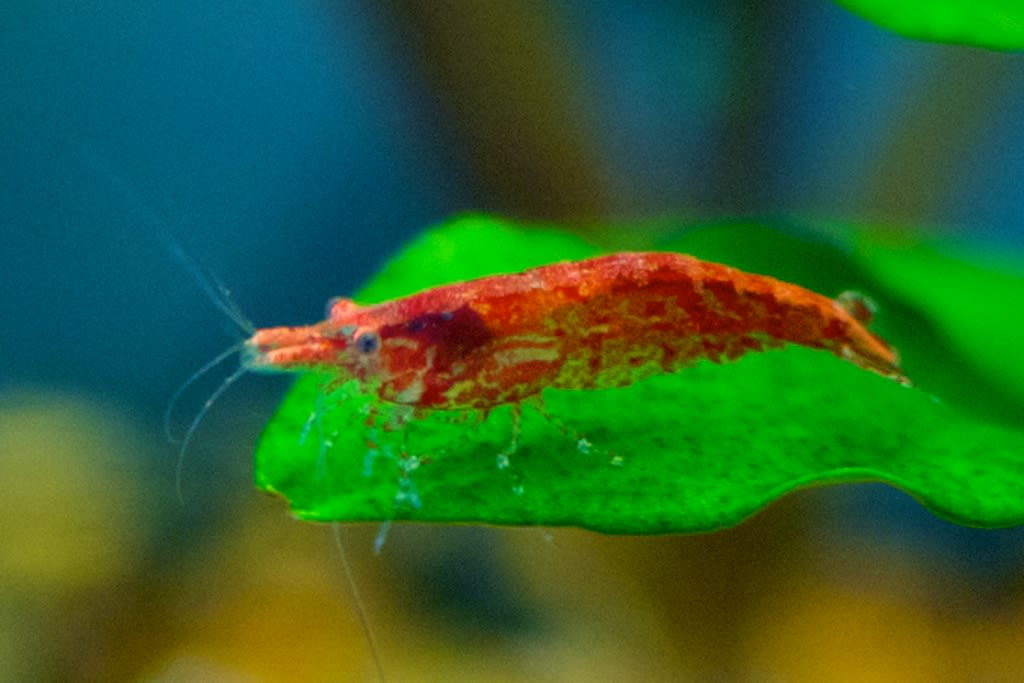
Cherry Shrimp
Neocaridina davidi
Parameter dashboard
18-28 °C
6.5-8
2.5 cm
Care guide
The cherry shrimp (Neocaridina davidi) is the shrimp most people start with, and for good reason. It is small, peaceful, endlessly colorful, and one of the easiest invertebrates to keep alive and breeding. The wild form from Taiwan and eastern China is a drab mottled brown, but decades of selective breeding have produced red, orange, yellow, green, blue, black, and striped "rili" lines. The familiar bright-red morph is what gave the species its common name. Adults reach about 2.5 cm; females generally carry stronger color, while males stay smaller and more see-through.
As a clean-up crew they graze all day on algae, biofilm, and leftover food, grabbing particles with tiny claw-tipped legs, and they will not touch healthy plants. Care is genuinely beginner-level: a planted nano tank of 19 litres or more works, and they happily live at 18-28 °C, often with no heater at all. The one thing to get right is minerals for molting. Keep the pH around 6.5-8 with a moderate GH and KH, and add crushed coral or a mineral supplement if your water is soft, or the shrimp will struggle to build a new shell after each molt. A sponge filter stops babies from being sucked in.
Unlike filter feeders such as the bamboo shrimp, cherry shrimp have no larval stage, so they breed readily in an ordinary freshwater tank. A berried female fans 20 to 30 eggs under her tail until hatching, and they hatch as fully formed miniature shrimp that begin grazing at once. Give a small group a stable, mature tank and a colony will build on its own.
Sources
- en.wikipedia.org — https://en.wikipedia.org/wiki/Neocaridina_davidi
- aquariumcoop.com — https://www.aquariumcoop.com/blogs/aquarium/cherry-shrimp-care
Further reading on identification and aquarium care.
Tankmate compatibility (sample)
Pairwise screening against other species in the database (prioritizing the same family when data is available).
Review first (3)
Caution or avoid from automated rules — confirm before mixing.
| Species | Assessment | Notes |
|---|---|---|
| Amano Shrimp Caridina multidentata Caution | Caution | Fish 2x+ larger may eat smaller tankmates Open pair in Compare → |
| Bamboo Shrimp Atyopsis moluccensis Caution | Caution | Fish 2x+ larger may eat smaller tankmates Open pair in Compare → |
| Vampire Shrimp Atya gabonensis Caution | Caution | Fish 2x+ larger may eat smaller tankmates Open pair in Compare → |
1 species with compatible assessment in this sampleCollapse to hide the list; use “Open pair in Compare” for the full matrix.
| Species | Assessment | Notes |
|---|---|---|
| Cardinal Shrimp Caridina dennerli Compatible | Compatible | No rule-based conflicts detected for this pair. Open pair in Compare → |
Same rule engine as Compare. Not a substitute for observation, tank size, or acclimation.
Related species
Was this page useful? Spot anything wrong?