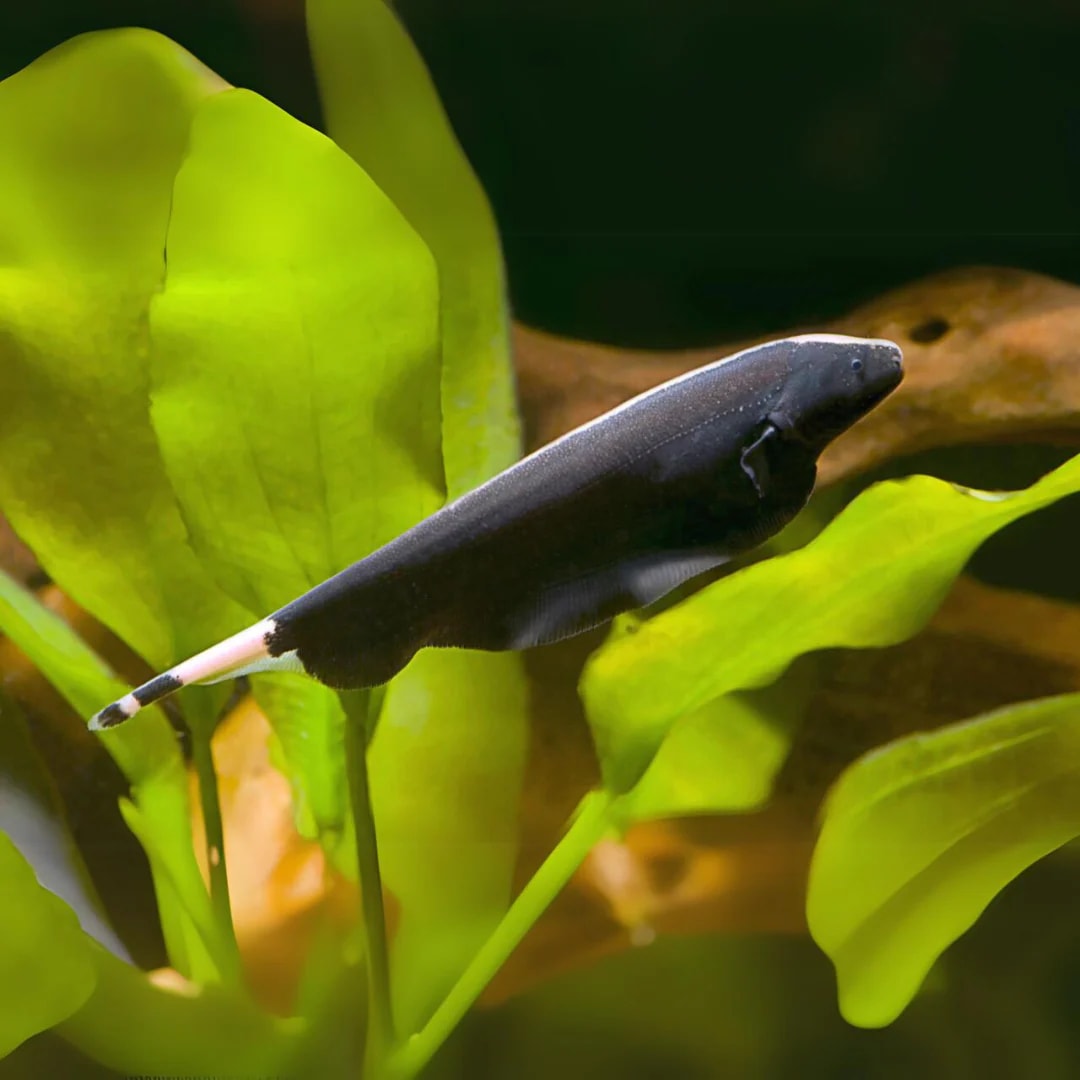
Black ghost knifefish
Apteronotus albifrons
Parameter dashboard
23-28 °C
6-8
50 cm
10 years
Care guide
The black ghost knifefish reaches about 50 cm total length in the wild and is one of the most distinctive freshwater fish in the hobby — an elongate, ribbon-like body in deep velvety black with two white bands on the tail and a white blaze on the snout. It comes from the Amazon and Orinoco basins across much of northern South America. Aquadiction recommends a minimum of 450 litres for one fish, with a long, broad swimming area and no sharp decorations that could injure its scale-less body. Temperature of 23–28 °C and pH 6.0–8.0 suit it. It navigates and hunts using a weak electrical field; the body contains electroreceptors that sense disturbances in the field. Diet is carnivorous — bloodworm, chopped prawn, earthworms, and frozen foods; some individuals can be weaned onto sinking pellets; verify feeding after purchase. It is peaceful toward fish too large to swallow but will eat small tankmates. It is nocturnal and appreciates secure retreats; do not make hand feeding a condition of successful care. FishBase records it from rapidly flowing creeks, so a blanket warning against strong filtration is misleading. Provide effective filtration and oxygenation alongside sheltered resting places, and judge the fish's behaviour rather than equating filter capacity with an unavoidable current problem.
Sources
- fishbase.se — https://www.fishbase.se/summary/Apteronotus-albifrons.html
- aquadiction.world — https://aquadiction.world/species-spotlight/black-ghost-knifefish/
Further reading on identification and aquarium care.
Tankmate compatibility (sample)
Pairwise screening against other species in the database (prioritizing the same family when data is available).
Review first (10)
Caution or avoid from automated rules — confirm before mixing.
| Species | Assessment | Notes |
|---|---|---|
| Asian bumblebee catfish Pseudomystus siamensis Caution | Caution | Fish 2x+ larger may eat smaller tankmates Open pair in Compare → |
| Cherry Shrimp Neocaridina davidi Caution | Caution | Fish 2x+ larger may eat smaller tankmates · this fish is not shrimp-safe, so shrimplets get eaten and adult shrimp can be harassed Open pair in Compare → |
| Galaxy betta Betta splendens Caution | Caution | Fish 2x+ larger may eat smaller tankmates · one of these species is highly aggressive and is usually best kept on its own Open pair in Compare → |
| Glowlight Danio Danio choprae Caution | Caution | Fish 2x+ larger may eat smaller tankmates Open pair in Compare → |
| Gold Cap Caudopunctatus Neolamprologus caudopunctatus Caution | Caution | Fish 2x+ larger may eat smaller tankmates Open pair in Compare → |
| Guayas cichlid Cichlasoma festae Caution | Caution | Fish 2x+ larger may eat smaller tankmates Open pair in Compare → |
| Harlequin rasbora Trigonostigma heteromorpha Caution | Caution | Fish 2x+ larger may eat smaller tankmates Open pair in Compare → |
| Pygmy gourami Trichopsis pumila Caution | Caution | Fish 2x+ larger may eat smaller tankmates Open pair in Compare → |
| Vampire Shrimp Atya gabonensis Caution | Caution | Fish 2x+ larger may eat smaller tankmates · this fish is not shrimp-safe, so shrimplets get eaten and adult shrimp can be harassed Open pair in Compare → |
| Whiptail Catfish Loricaria simillima Caution | Caution | Fish 2x+ larger may eat smaller tankmates Open pair in Compare → |
2 species with compatible assessment in this sampleCollapse to hide the list; use “Open pair in Compare” for the full matrix.
| Species | Assessment | Notes |
|---|---|---|
| Chinese algae-eater Gyrinocheilus aymonieri Compatible | Compatible | No rule-based conflicts detected for this pair. Open pair in Compare → |
| Tinfoil barb Barbonymus schwanenfeldii Compatible | Compatible | No rule-based conflicts detected for this pair. Open pair in Compare → |
Same rule engine as Compare. Not a substitute for observation, tank size, or acclimation.
Was this page useful? Spot anything wrong?