Intermediate
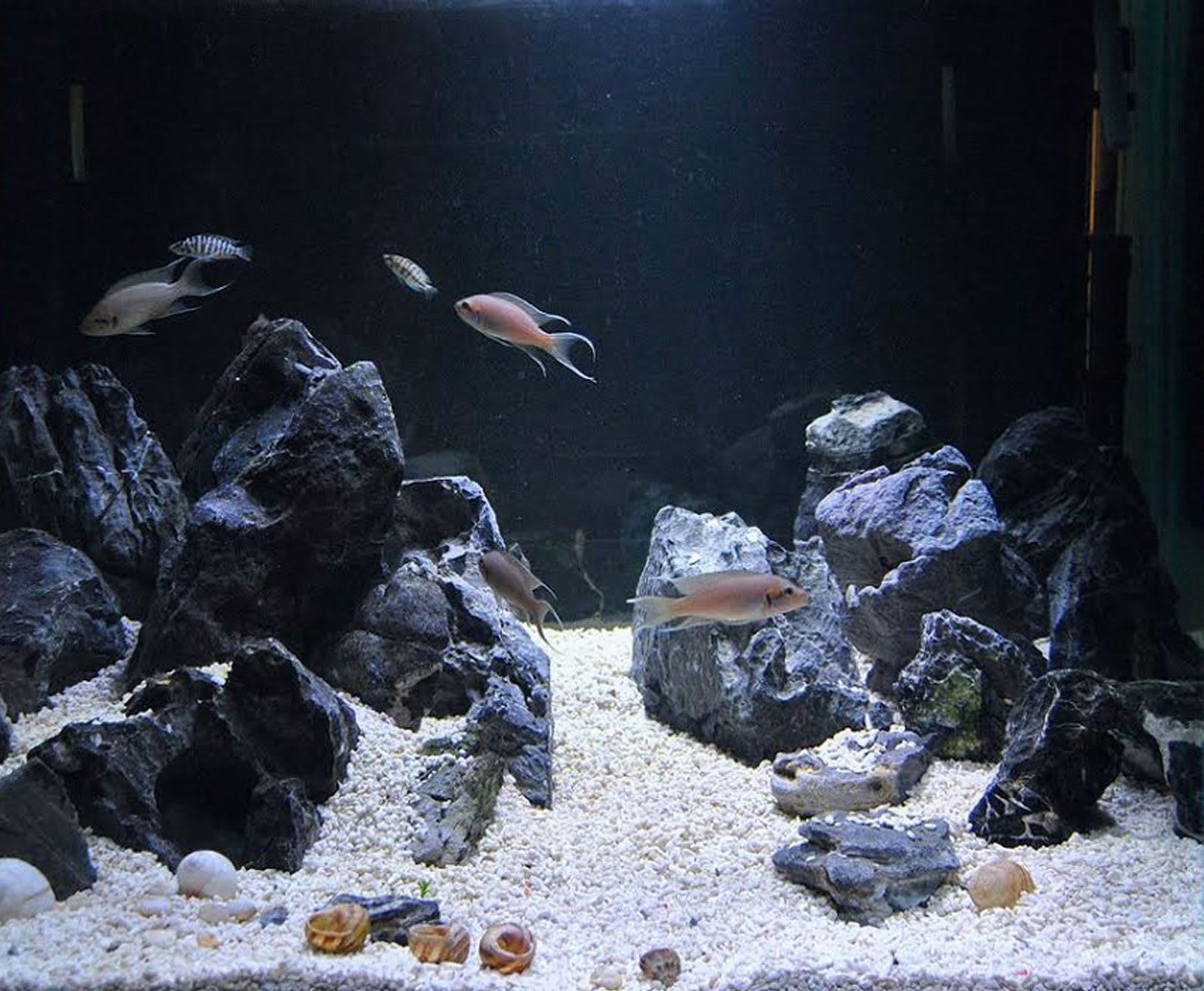
Lake Tanganyika Rockery
Hard, alkaline water and rock stacks for shell dwellers and cichlids.
Volume
80 L
Est. monthly cost
~$32
Water target
24–27 °C · pH 7.8–8.5
Overview
High pH and GH with aragonite sand, calcareous rock, and minimal plants—focus on territory design and water chemistry stability.
Build rock piles with caves and sight lines; avoid sharp edges where fish flash. Shell beds for shell dwellers should sit on flat sand patches.
Filtration with strong turnover and polished surface flow helps oxygenation in warmer water. UV optional for clarity.
Plants are limited: epiphytes on rock, algae grazing on hardscape, or none. Lighting is functional rather than aquascape-forward.
Step-by-step setup guide
Tank & substrate
Day 1Set up the 80 L tank on a sturdy stand—rock builds are heavy. Use aragonite sand or crushed coral as substrate, 3–5 cm deep. These calcareous substrates naturally buffer pH upward toward 8.0–8.5 and maintain the high GH/KH that Tanganyikan cichlids require. Rinse substrate thoroughly before adding.
- ▸Aragonite sand dissolves slowly, contributing calcium and carbonate over months—it's a passive pH buffer.
- ▸Pool filter sand works too but won't buffer pH; you'll need to add crushed coral to the filter instead.
Rock structure & territory design
Day 1–2Build distinct rock piles using limestone, Texas holey rock, or ocean rock—all naturally raise hardness. Create 3–4 separate cave clusters with clear sight-line breaks between them. Each cluster becomes a territory. Stack rocks securely, ensuring no piece can topple when fish dig underneath. Leave open sand corridors between structures for swimming and territory boundaries.
- ▸Place the largest rocks directly on the glass bottom (not on sand) to prevent undermining by digging cichlids.
- ▸Silicone or aquarium-safe epoxy critical joints—a collapsed rock pile can crack glass.
- ▸Create caves with multiple entrances so weaker fish aren't cornered.
Shell beds (for shell dwellers)
Day 2Designate one flat sand area (about 20 × 15 cm) as the shell bed. Place 15–20 escargot shells or similar-sized shells in a loose cluster. Neolamprologus multifasciatus and similar shell dwellers will arrange these themselves, burying and repositioning shells to suit their colony. Leave this area near the front glass for easy observation of their fascinating behavior.
- ▸Boil shells for 10 minutes before adding to sterilize them.
- ▸Shell dwellers are surprisingly fierce defenders—place the shell bed away from other territories.
Minimal planting (optional)
Day 2Tanganyikan tanks are traditionally plant-free, but you can attach Anubias nana or Java fern to rocks for a touch of green. These epiphytes tolerate hard, alkaline water and don't need substrate. Avoid rooted plants—cichlids will uproot them while digging. Algae growth on rocks is natural and even desirable as grazing surface.
- ▸Super glue gel is the fastest way to attach Anubias to rock—it cures in seconds underwater.
- ▸Accept that plants are accent pieces here, not the focus. Some Tanganyikan setups run with zero plants and look stunning.
Equipment installation
Day 2–3Install a canister or large HOB filter providing 8–10× turnover (640–800 L/h). Tanganyikan cichlids need well-oxygenated, clean water. Point the outflow to create moderate surface agitation. Set the heater to 25–26 °C. Lighting is functional: a standard LED on a timer for 8 hours. Optional: a UV sterilizer inline with the filter to maintain crystal clarity.
- ▸Strong filtration is critical—cichlids produce more waste per gram than tetras.
- ▸An air stone adds extra oxygenation, which these warm-water fish appreciate.
Water chemistry & cycling
Week 1–3Fill with tap water (most municipal water is already hard enough for Tanganyikans) and add dechlorinator. Target parameters: pH 7.8–8.5, GH 10–20, KH 10–15. If your tap is soft, add a mineral buffer or mix in cichlid salts. Cycle the tank with a bacterial starter and ammonia source. Test weekly. Tanganyikan cichlids are sensitive to ammonia—the cycle must be fully complete before stocking.
- ▸Cichlid-specific salt mixes (e.g. Seachem Tanganyika Buffer) make water chemistry straightforward.
- ▸Test KH especially—it must stay above 8 to prevent dangerous pH crashes.
Stocking the Tanganyikan community
Week 4–6An 80 L tank is small for Tanganyikans—pick ONE primary species rather than stacking three. Recommended path: Week 4, add 6–8 Neolamprologus multifasciatus to the shell bed; they will colonize and breed without overwhelming the tank. Optional pairing: 2–3 Neolamprologus leleupi or a single pair of Julidochromis ornatus in a separate rock cluster, but only if territories are clearly broken up. Avoid brichardi colonies (they fill any tank in a year) and never add Cyphotilapia frontosa here—adults reach 30+ cm and need 400 L+ minimum. Watch for territorial aggression in the first 48 hours after each addition.
- ▸Rearrange rocks slightly when adding new fish—this resets established territories and reduces aggression.
- ▸Most Tanganyikan species need 120 L+ to thrive; 80 L is a shell-dweller specialty tank, not a community tank.
Long-term management
Month 2+Tanganyikan tanks are stable once established but require consistent water chemistry. Weekly: 15–20% water change with buffered, temperature-matched water. Brush rocks to dislodge detritus without destroying beneficial biofilm. Monthly: test KH and GH, clean prefilter sponges, check heater calibration. Watch for breeding behavior—many Tanganyikan species breed readily in captivity. Remove or relocate fry to prevent overcrowding and aggression.
- ▸Never do large (>30%) water changes—Tanganyikan cichlids are sensitive to sudden parameter shifts.
- ▸Breeding pairs become extremely territorial; have a plan for fry (grow-out tank or rehoming).
Maintenance schedule
Weekly: 15–20% water change with hard, buffered water; brush rocks to control detritus. Monthly: test KH/GH, clean prefilter sponges.
Suggested catalog links
Each link opens its catalog page. Import adds the fish and plants to My Tank; add the gear you already run there.
Plants
Import to My Tank
Applies tank volume, temperature, pH, light, CO₂ flag, and substrate from this blueprint, then adds any fish, plants, and equipment rows that match listed slugs or equipment ids in the live catalog.