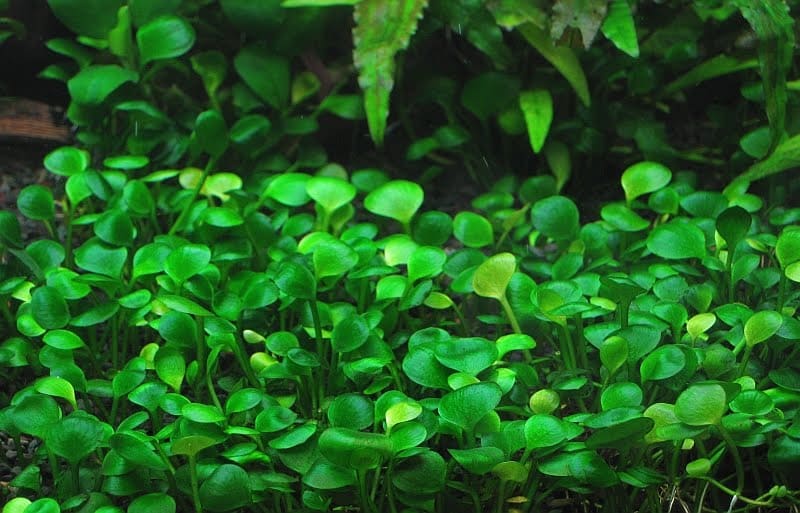
Rough waterclover
Marsilea hirsuta
Marsileaceae
Foreground
Easy
Survival dashboard
Light
Medium
CO2
Optional
Ideal temp
18–28 °C
pH
6–7.5
Aquascaping
Max height5 cm
Growth rateMedium
Substratesand
OriginAustralia (also naturalized elsewhere)
Price$
Trim schedule (hint)
Expect trimming about every 2–4 weeks depending on light and nutrients.
Description
This plant is sold as a foreground carpeting species, but depending on the conditions it may grow two completely different leaf forms. Submerged, Marsilea hirsuta produces narrow, upright leaves that look more like a grass than a clover. Only when it grows emersed or under very strong light does it produce the four-lobed clover leaves that give the plant its common name.
It spreads by runners that creep across the substrate, sending up new leaves at each node. Given time and stable conditions, it forms a low, dense carpet that covers the foreground. The growth rate is moderate and the plant responds well to regular trimming, which encourages lateral spread.
Moderate light and a fine-grained substrate like sand help the runners establish quickly. CO₂ injection is not essential but speeds up carpet formation. In the aquarium it does well across roughly 18 to 28 °C and pH 6 to 7.5, though these figures are estimates rather than published cultivation data.
The transition from tissue culture to submerged growth can take several weeks, during which the plant may shed its original emersed leaves. This is normal and not a sign of failure — new submerged-adapted leaves will follow. In nano tanks it stays low and compact, but in larger tanks it may need occasional thinning to prevent the runners from overlapping.
Keep this species? Spot anything off?