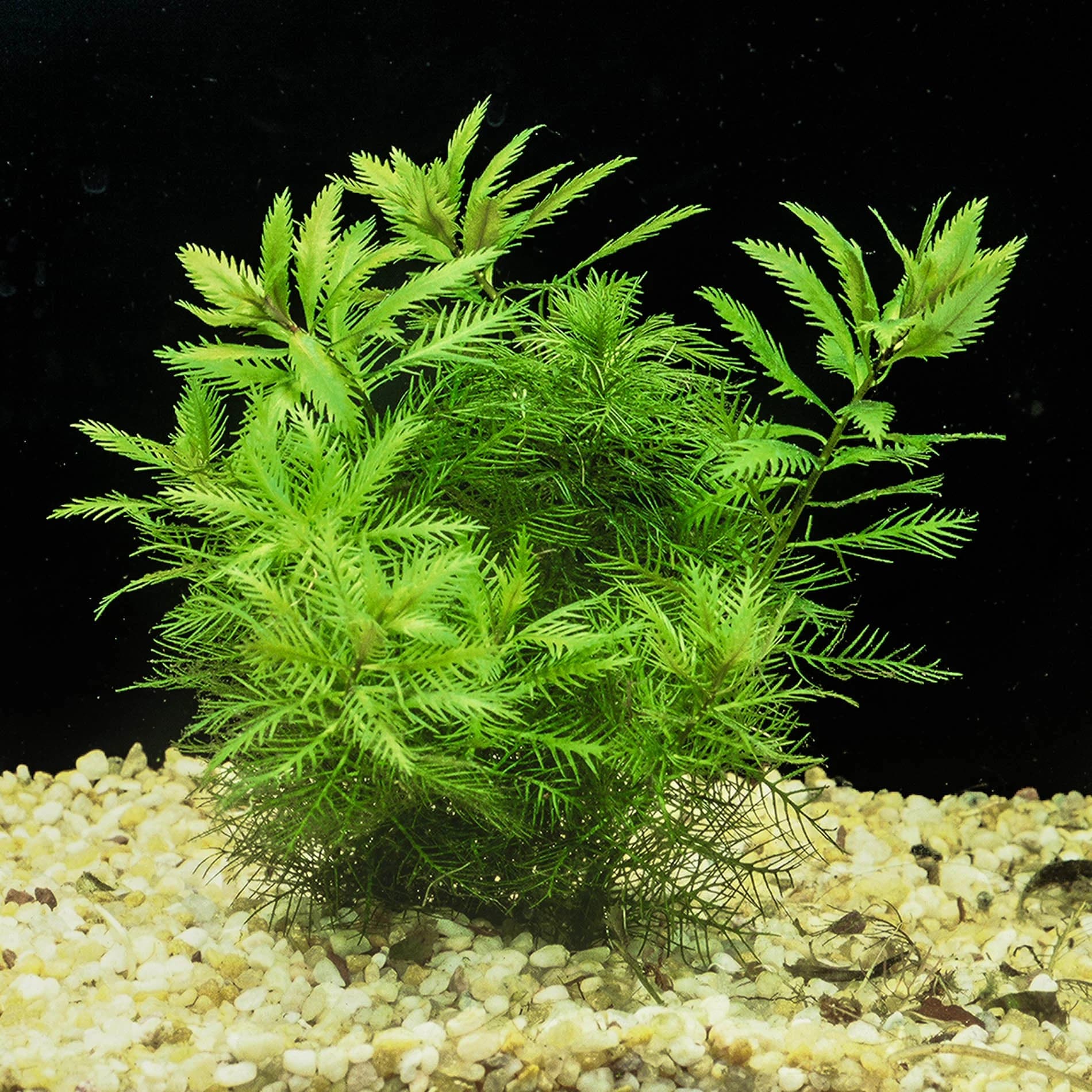
Mermaid Weed
Proserpinaca palustris
Survival dashboard
High
Added CO₂ beneficial
20–25 °C
5–7.5
Aquascaping
Substrate compatibility does not specify planting depth. Follow the care instructions below, especially for exposed rhizomes and crowns.
Trim schedule (hint)
Trim or thin as the plant fills its space. Let new planting establish, and watch for shaded lower growth.
Description
Proserpinaca palustris, known as mermaid weed, is a stem plant of the Haloragaceae family with a range across the eastern and south-eastern United States, some Caribbean islands, and Central and parts of South America. In the wild it grows in ditches, ponds, rivulets and swamplands, and it varies noticeably from one region to the next. The plant has been cultivated in the United States and Europe for decades; it appears in German aquarist literature from the 1950s, and it reached a wider audience when it was imported as a new plant from Cuba. Newly planted, it keeps its emersed green form at first and needs time to convert to orange-red submersed leaves. Medium to strong light supports the underwater foliage, and added CO₂ can improve growth. Lamp power alone does not measure the light reaching the plant. The Cuban form, which is what European shops stock, grows 10 to 40 cm tall and 5 to 10 cm wide. The red colour depends on feeding: low nitrate, roughly 5 to 10 mg/l, together with high phosphate of about 1.5 to 2 mg/l, gives compact growth and a deep orange-red; higher nitrate turns it light orange or green. A steady iron supply keeps the colour from fading. It makes few side shoots, so to prune it, cut off the upper part and replant it; the old stem then sends out new shoots.
Sources
- aquariumcoop.com — https://www.aquariumcoop.com/blogs/aquarium/how-to-pick-the-best-planted-aquarium-light
- flowgrow.de — https://www.flowgrow.de/db/aquaticplants/proserpinaca-palustris
Further reading on identification and aquarium care.
Was this page useful? Spot anything wrong?