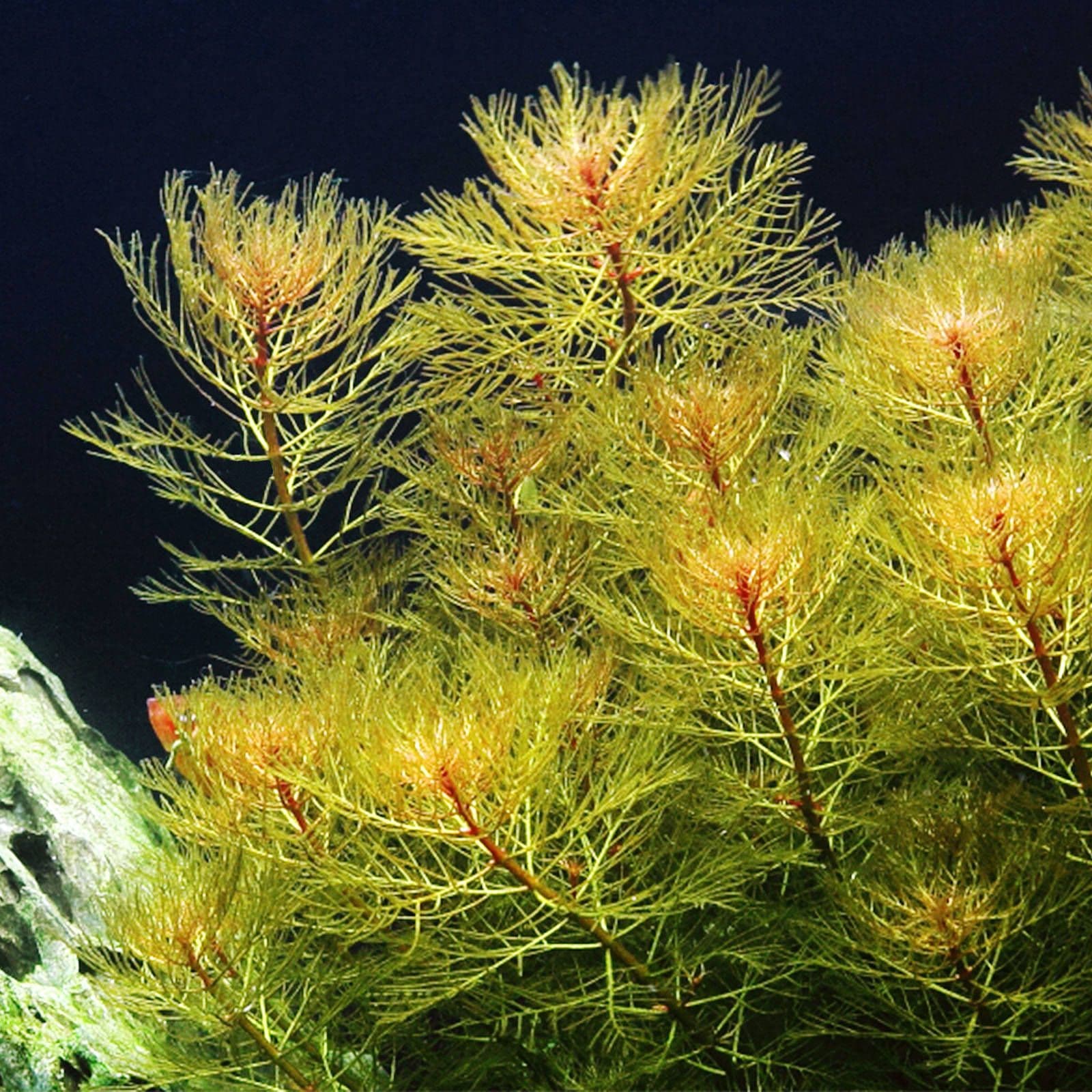
Myriophyllum Tuberculatum
Myriophyllum tuberculatum
Survival dashboard
High
Added CO₂ required
18–24 °C
5–7
Aquascaping
Substrate compatibility does not specify planting depth. Follow the care instructions below, especially for exposed rhizomes and crowns.
Trim schedule (hint)
Check growth regularly. Trim or thin when shoots crowd neighbors, reach the surface, or shade lower growth.
Description
For about twenty years this milfoil was sold under the wrong name. The correction has a date: the red watermilfoil traded as Myriophyllum mattogrossense and M. pinnatum was identified as M. tuberculatum by the botanist A. E. Orchard in 1994, four years after Christel Kasselmann imported the true, green M. mattogrossense from Ecuador. Both wrong names are now listed as misapplied, and in the United States a different reddish-brown Florida species is usually sold under this one instead.
The plant itself is Asian, from slow-flowing and standing waters in India, Pakistan, southern China, Malaysia, Indonesia and Australia. Grown well, the leaf whorls reach about 10 cm across and take on a rusty red.
This is a demanding stem plant. Provide strong light at the shoots, added CO₂ and reliable nutrition; do not choose a lamp solely by a watts-per-volume rule. Nitrate wants to sit around 5 to 15 mg/l and phosphate around 1 to 2, and neither should ever reach zero or growth stalls. It is hungrier for iron and trace elements than most stem plants. Starve it and the stems stay dark and small; starve it badly and the growing tip dies outright.
The optimum temperature is 18 to 24 °C, cooler than most tropical stem plants, with pH 5 to 7 and soft water at 0 to 8 dKH. Growth is fast once the plant is settled, and it runs to the surface and branches there. Trim by lifting the strong upper section and replanting it, since the rooted base re-sprouts slowly.
Sources
- aquariumcoop.com — https://www.aquariumcoop.com/blogs/aquarium/how-to-pick-the-best-planted-aquarium-light
- flowgrow.de — https://www.flowgrow.de/db/aquaticplants/myriophyllum-tuberculatum
Further reading on identification and aquarium care.
Was this page useful? Spot anything wrong?