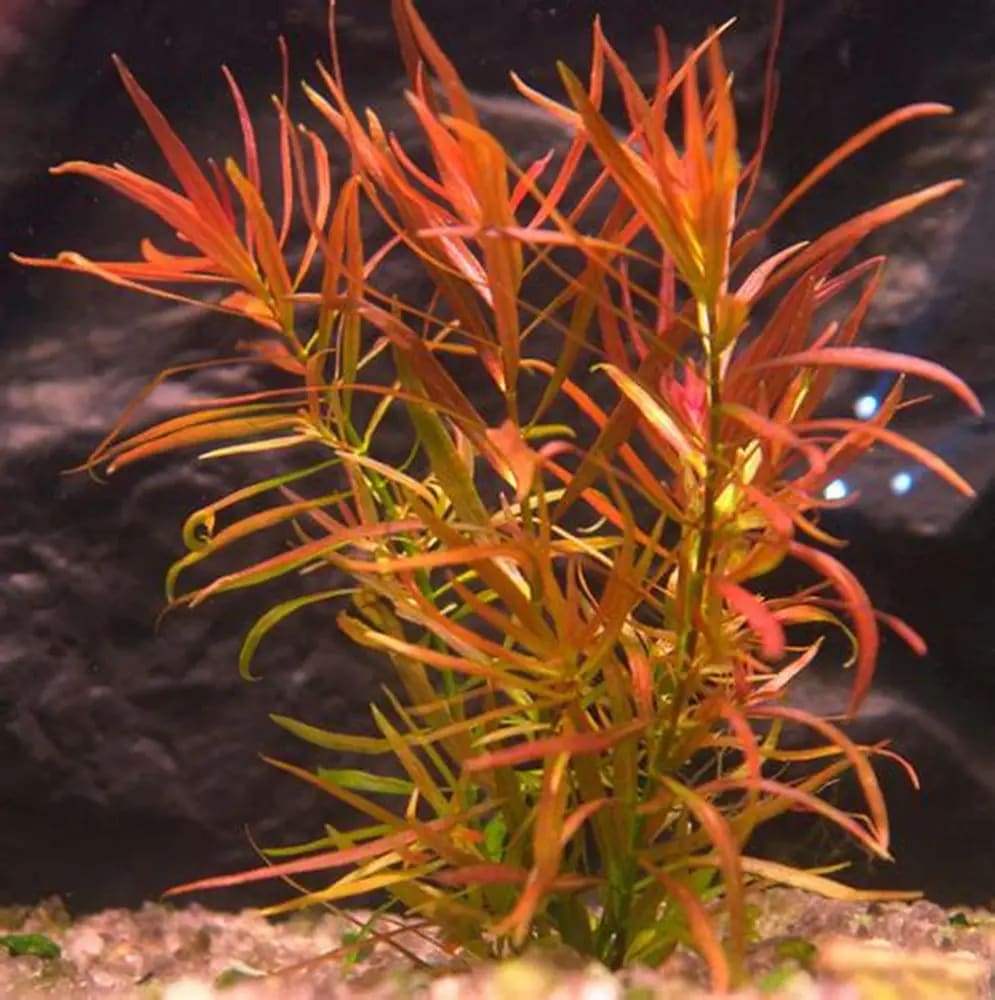
Long Beach Primrose-willow
Ludwigia brevipes
Survival dashboard
Medium
Added CO₂ beneficial
22–26 °C
4.5–7
Aquascaping
Substrate compatibility does not specify planting depth. Follow the care instructions below, especially for exposed rhizomes and crowns.
Trim schedule (hint)
Check growth regularly. Trim or thin when shoots crowd neighbors, reach the surface, or shade lower growth.
Description
Ludwigia brevipes and Ludwigia arcuata are sold as each other often enough to be worth checking. Submersed, the two narrow-leaved stems are easy to confuse. The reliable separation happens above the waterline, in flower: brevipes has smaller, narrower petals and hairless stems, while arcuata has relatively large petals and stems with a light covering of hairs.
The plant is North American. It grows in boggy ground along the Atlantic coastal plain of the southeastern United States, in Virginia, the Carolinas and northwestern Florida, and its common name is Long Beach primrose-willow.
Light does most of the work here. Medium to strong light is important for submerged growth. Supply macro- and micronutrients as the stems develop; added CO₂ can improve the result when light and nutrition are adequate. CO2 injection is therefore optional rather than required. Colour follows the nutrient balance, with low nitrate against relatively high phosphate turning the shoot tips reddish to orange.
Suitable cultivation conditions are 22 to 26 °C and pH 4.5 to 7, with carbonate hardness from 2 to 10 dKH, medium to high light, fast growth and medium difficulty. Trimming and propagation are the same job: cut off a shoot tip or a lateral shoot and replant it, and the cut plant answers with more laterals and a bushier habit. It suits planting in groups in the midground with Micranthemum umbrosum or Bacopa australis for contrast.
Sources
- aquariumcoop.com — https://www.aquariumcoop.com/blogs/aquarium/how-to-pick-the-best-planted-aquarium-light
- flowgrow.de — https://www.flowgrow.de/db/aquaticplants/ludwigia-brevipes
Further reading on identification and aquarium care.
Was this page useful? Spot anything wrong?