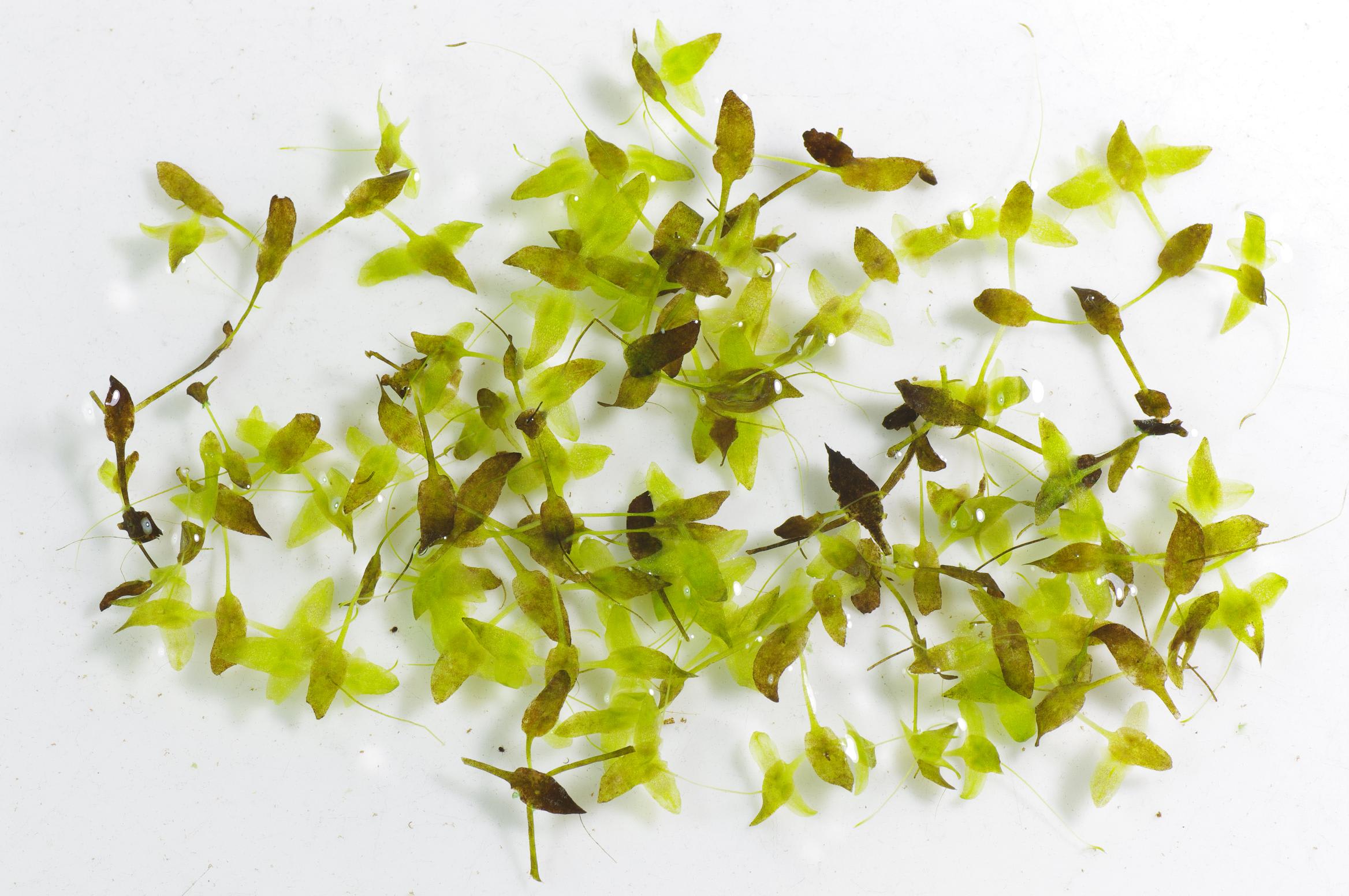
Star Duckweed
Lemna trisulca
Survival dashboard
Medium
No added CO₂ needed
10–22 °C
5–8
Aquascaping
Substrate compatibility does not specify planting depth. Follow the care instructions below, especially for exposed rhizomes and crowns.
Trim schedule (hint)
Check growth regularly. Trim or thin when shoots crowd neighbors, reach the surface, or shade lower growth.
Description
This duckweed does not look like duckweed. Instead of round floating pads, Lemna trisulca grows as translucent, forked fronds that stay submerged just below the surface — only rising to the top when the plant is healthy and actively growing. It is also called ivy duckweed or star duckweed for the star-shaped clusters the fronds form.
The key difference from common duckweed (Lemna minor) is that L. trisulca is predominantly a cool-water plant. It does best at 10 to 22 °C, which makes it one of the few floating plants suited to unheated tanks and coldwater setups. In warm tropical aquariums it struggles, turns pale, and eventually disintegrates.
It is more delicate than other duckweeds and easier to remove in whole clumps because the submerged fronds tangle together. It still spreads quickly under good conditions, but it does not form the impenetrable surface mat that common duckweed creates.
Propagation is by fragmentation — each fork breaks into separate fronds, each of which becomes a new plant. In winter it forms shorter, broader fronds that sink and continue growing more slowly. pH tolerance is broad at 5 to 8, and CO₂ is not needed.
Source
Further reading on identification and aquarium care.
Was this page useful? Spot anything wrong?