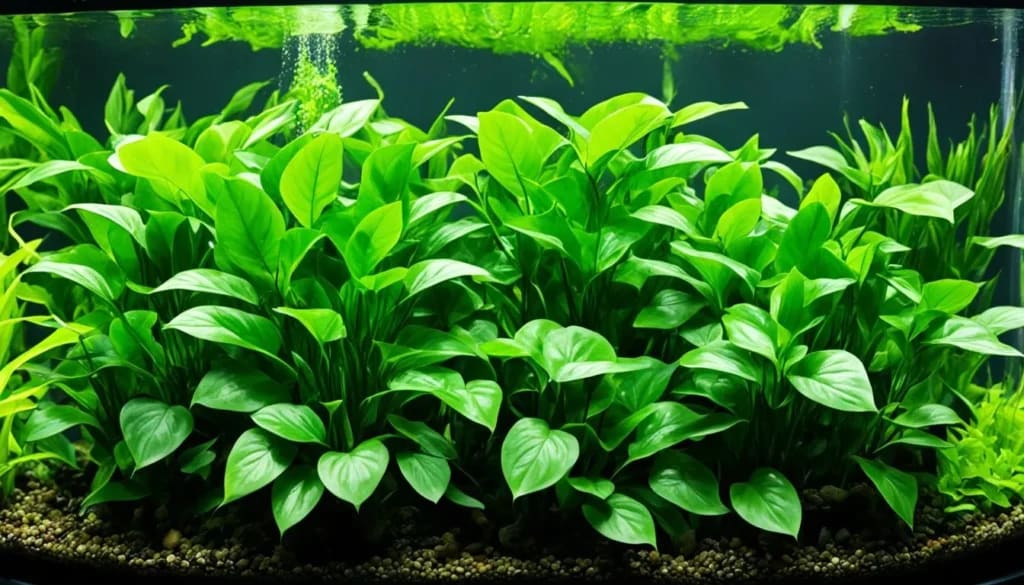
Hastifolia Anubias
Anubias hastifolia
Survival dashboard
Low
Added CO₂ beneficial
22–26 °C
5–7
Aquascaping
Substrate compatibility does not specify planting depth. Follow the care instructions below, especially for exposed rhizomes and crowns.
Trim schedule (hint)
Allow time for new growth. Remove deteriorating leaves or shoots and tidy the plant when it outgrows its position.
Description
The arrow-shaped leaves with a prominent central vein and long petioles are the clearest way to tell Anubias hastifolia from other Anubias species. This West African plant grows slowly and steadily, producing leaves that are noticeably longer than they are wide with a slight spear-point shape at the tip — the species name hastifolia means 'spear-leaf'.
The rhizome creeps across the surface of wood or stone and must not be buried. Like all Anubias, it rots if the rhizome is covered by substrate. Tie or glue the rhizome to hardscape with fishing line or superglue until the roots take hold. Growth is slow; judge establishment by healthy new leaves rather than expecting a fixed interval between them.
It grows well at 22 to 26 °C with pH 5 to 7. Low light is sufficient and CO₂ injection is not needed. In a bright layout, choose a shaded position if algae begins to collect on the long-lived leaves.
The tough, leathery leaves are resistant to plant-eating fish, which makes it one of the few plants suitable for African cichlid tanks. Propagation is by cutting the rhizome into sections, each with at least three to four leaves and a few roots. It also grows emersed in paludariums and ripariums.
Source
Further reading on identification and aquarium care.
Was this page useful? Spot anything wrong?