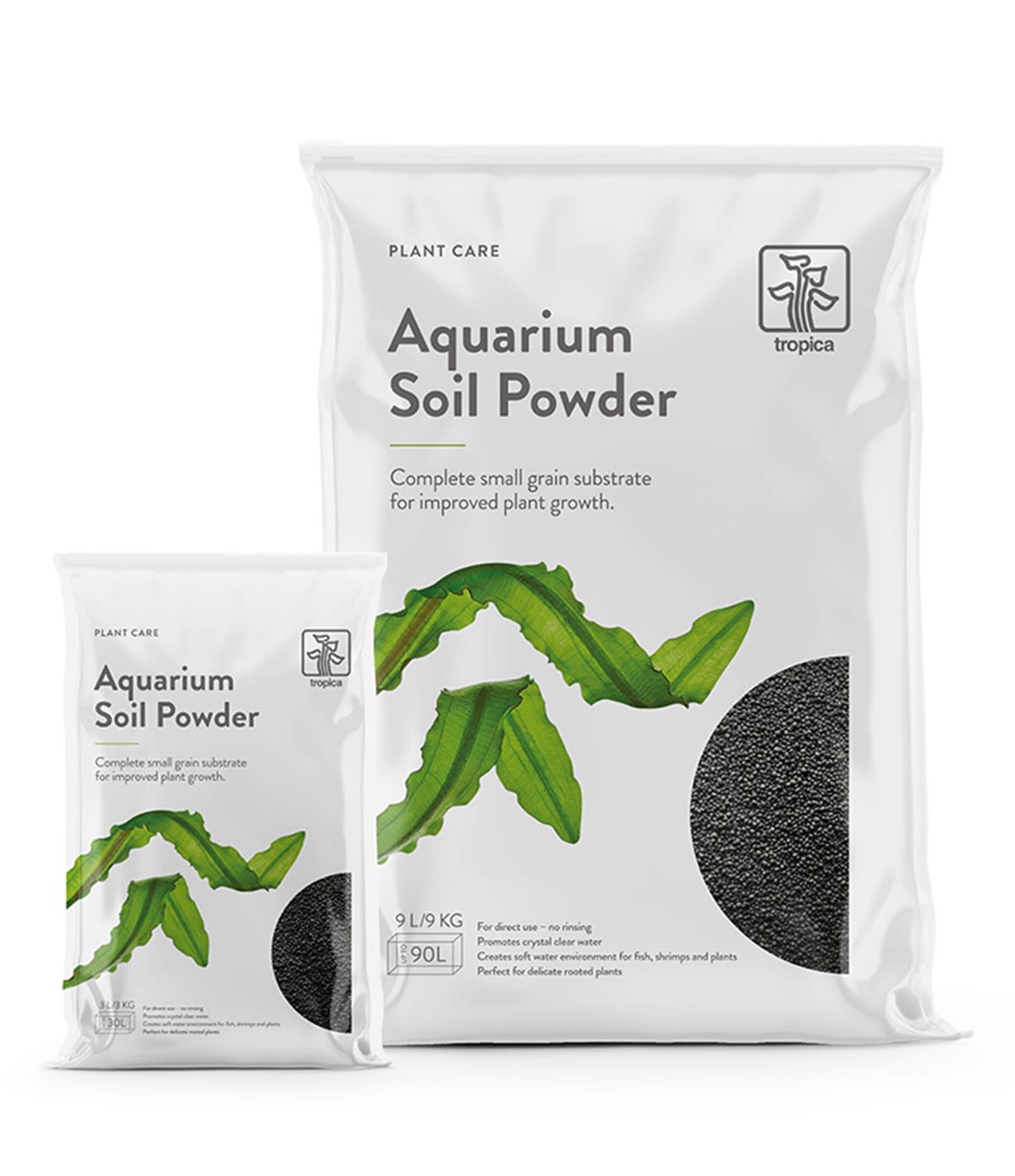
Representative photo. The product you buy may differ in size, colour or packaging.
Aquarium Soil Powder (9L)
Tropica · Aquarium Soil Powder (9L)
substrate
Used for: Planted tanks, Aquascaping
Specifications
| Specification | Value |
|---|---|
| Grain size | 1–2 mm |
| Material | Naturally occurring volcanic minerals |
| pH (as stated) | Contributes to a natural reduction in pH |
Source checked on 2026-09-15.
Description
Aquarium Soil Powder is the fine grade of Tropica's volcanic granulate: 1-2 mm grain against 2-3 mm for the standard Aquarium Soil. Both are complete substrates, which in Tropica's usage means the bed needs nothing under it and no gravel cap over it - that is what separates the Soil line from their other product simply called Substrate, a root-zone nutrient depot you are told to cover with at least 3-4 cm of gravel. The fine grade is aimed at foreground and small plants, where a 2-3 mm granule is too coarse to hold a delicate stem, and at scapes wanting a finer texture in the front third. Plan for the water chemistry. Tropica describes Aquarium Soil as a Japanese natural volcanic granulate that naturally reduces KH and pH and improves the plants' ability to absorb nutrients, and the bag adds that it creates a soft-water environment for fish, shrimps and plants. The stated cost of that is a schedule, not a caveat: change 25-50 percent of the water at least twice a week for the first four weeks after setup. Treat it as a setup cost of the substrate rather than optional advice. Practical details from the bag: it is for direct use with no rinsing, and it comes in 3 L / 3 kg and 9 L / 9 kg, marked for roughly 30 L and 90 L tanks respectively. For a precise figure Tropica gives the formula - length x width x layer depth in centimetres, divided by 1000, in litres. Their worked example is a 90 x 60 cm tank at 8 cm deep needing 43.2 L.
Source
Further reading on identification and aquarium care.
Was this page useful? Spot anything wrong?