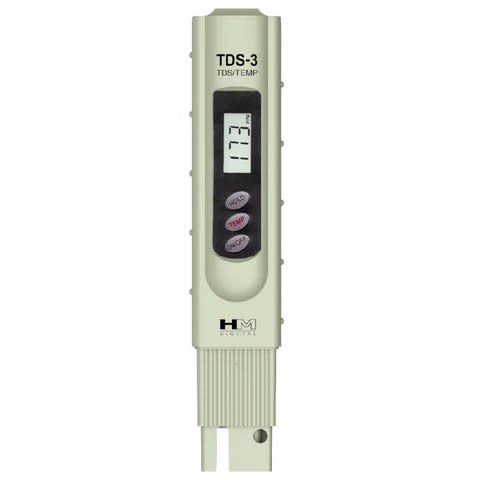
Representative photo. The product you buy may differ in size, colour or packaging.
TDS meter
monitoring
Used for: Water testing, Tank maintenance
Description
A handheld TDS meter estimates total dissolved solids from electrical conductivity and a conversion scale. The display is commonly in ppm or mg/L. Different scales can give different TDS numbers for the same conductivity, so check the meter’s scale when comparing readings or following a product’s water-mixing instructions. It can help compare source water, filtered water and prepared aquarium water. Record readings using a consistent instrument and mode. TDS is a bulk indicator: it does not separately report general hardness, carbonate hardness, ammonia or nitrate. Use tests for those parameters when you need them. Choose for the sample range and check the stated accuracy, resolution and temperature compensation. Calibrate as the manufacturer directs with a suitable standard near the range being measured. The HM Digital TDS-3 uses a fixed conversion approach, while the COM-100 offers selectable modes; neither feature should be assumed for every pen. Immerse only the permitted sensing area and follow the cleaning instructions. HM Digital warns that its ordinary pocket meters are not watertight, while identifying the COM-100 as a different, submersible design. Keep the cap, electrodes and battery compartment in the condition required by your model. A low TDS number is not proof that water is suitable for every aquarium.
Sources
- hmdigital.com — https://hmdigital.com/tds-3/
- hmdigital.com — https://hmdigital.com/wp-content/uploads/2022/12/com100manual.pdf
- hmdigital.com — https://hmdigital.com/product-maintenance/
Further reading on identification and aquarium care.
Was this page useful? Spot anything wrong?