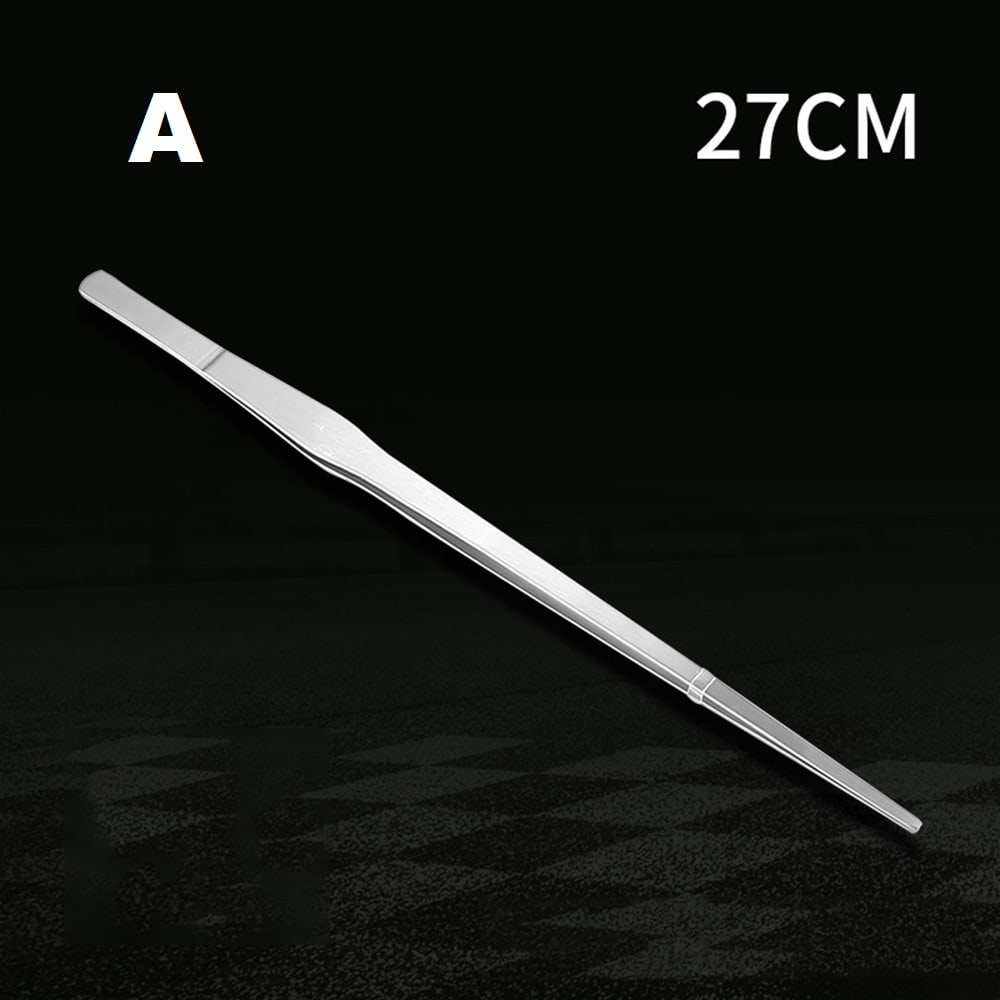
Representative photo. The product you buy may differ in size, colour or packaging.
Straight tweezers
accessory
Used for: Aquascaping, Planted tanks, Tank maintenance
Specifications
| Specification | Value |
|---|---|
| Length | 27 cm |
| Material | Stainless steel with carbonised coating |
| Tip finish | Rubber coated tips |
Source checked on 2026-10-02.
| Specification | Value |
|---|---|
| Length | 10.6" |
| Material | Stainless Steel |
Source checked on 2026-10-02.
| Specification | Value |
|---|---|
| Length | 10.6" |
| Material | Stainless Steel |
Source checked on 2026-10-02.
Description
Straight aquascaping tweezers hold aquatic plants while positioning them in the substrate. Their narrow working tips help with planting between existing plants and around stone or driftwood. A straight pair is a useful choice where you can approach the planting position directly; curved pairs offer an alternative tip orientation, so compare the access available in your layout. Choose the length for the planting depth and access you need rather than treating 27 cm as a standard for every tank. ADA Pinsettes come in 16, 21, 27 and 30 cm lengths. Check tip alignment, spring resistance and how comfortably you can hold and release a plant at the working position. Fine tips suit small planting spaces; broader grip designs are available for plants with a larger base. ADA specifically recommends its wider, thicker Grip-type tips for Cryptocoryne and Echinodorus. Tip finish varies by model. Some pairs have textured tips; Fluval Straight Forceps use rubber-coated tips and carbonized stainless steel. These details describe grip and construction, rather than guaranteeing that a plant cannot be damaged. Sets can include both straight and curved tweezers, but check the length of the actual straight pair rather than using the size of another tool in the kit. Rinse stainless aquascaping tools after use and dry them before storage, especially after saltwater work. Stainless steel can still corrode if salts remain on the surface; a coating or stainless-steel label does not remove the need for care.
Sources
- adana.co.jp — https://www.adana.co.jp/en/contents/products/na_layout/detail02.html
- jbl.de — https://www.jbl.de/?mod=productsv2&func=detail&id=25181399&country=il&lang=en
- fluvalaquatics.com — https://fluvalaquatics.com/us/shop/product/straight-forceps-10-6-27-cm
Further reading on identification and aquarium care.
Was this page useful? Spot anything wrong?