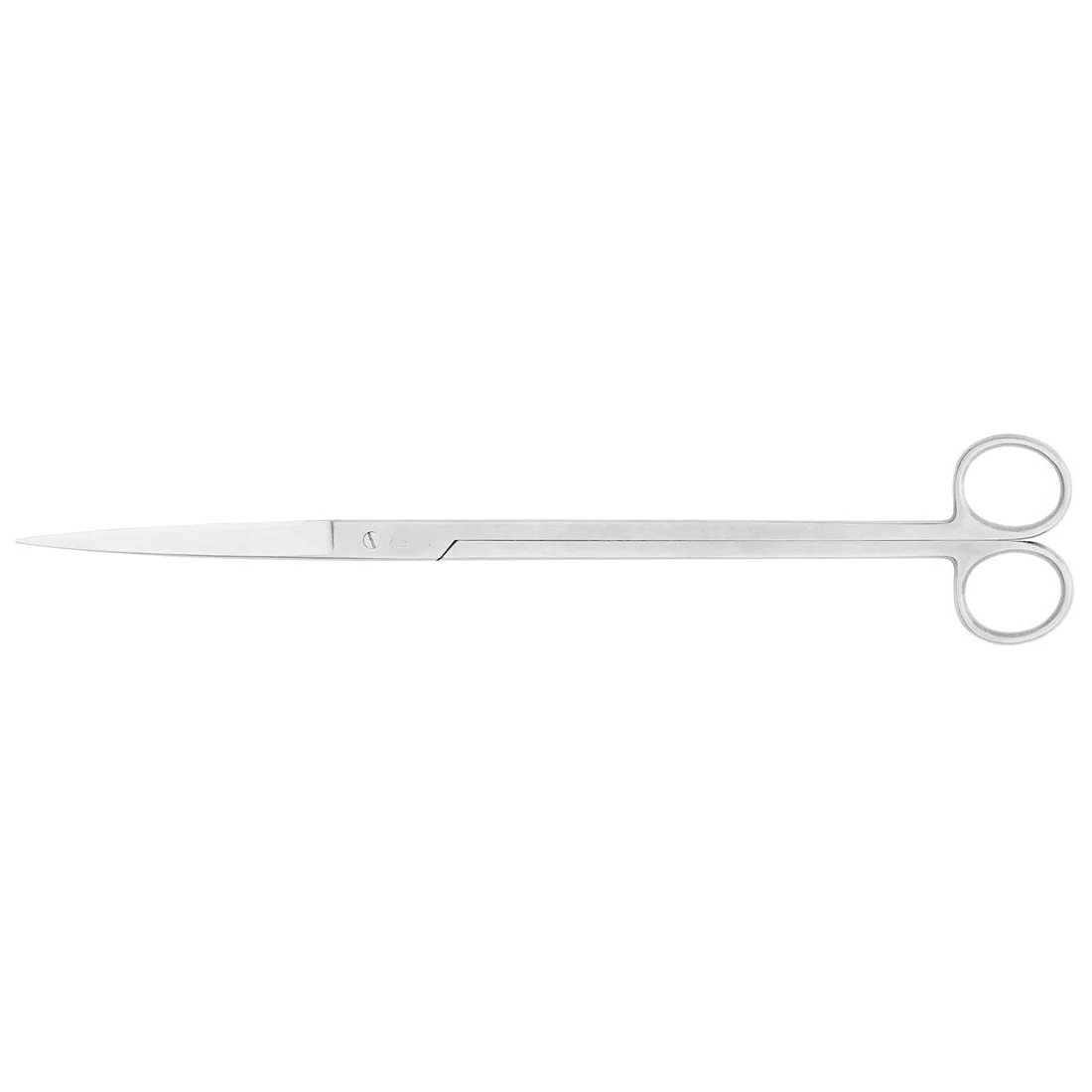
Representative photo. The product you buy may differ in size, colour or packaging.
Straight scissors
accessory
Used for: Aquascaping, Planted tanks, Tank maintenance
Specifications
| Specification | Value |
|---|---|
| Length | 10 in (25.4 cm) |
| Shape | Straight |
| Material | Stainless steel |
Source checked on 2026-10-02.
| Specification | Value |
|---|---|
| Length | 9.8 in (25 cm) |
| Shape | Straight |
| Material | Stainless steel |
| Pieces | 1 |
Source checked on 2026-10-02.
Description
Straight aquascaping scissors cut and trim aquatic plants, including preparing plants before planting and pruning growth in an established aquarium. Their blades provide a direct cutting approach. A shorter pair is useful for preparation outside the tank or work near the water surface; a longer pair provides reach in deeper or larger aquariums. Choose length and blade shape together. Straight and curved versions are common, while wave designs allow a lower cutting angle across foreground growth. Compact spring scissors close by squeezing their handles and suit tasks such as moss trimming or removing individual leaves in a small aquarium. For confined work near rocks, compare the room available for the handles and blades as well as the stated length. Match the design to the plants and the cutting approach. ADA recommends the straight version of its Pro-Scissors Short for thick stems and the curved version for low plants; this is guidance for that design, rather than a rule that every straight pair is limited to thick plants. Check the length of the selected model: the straight pairs in the specifications below are about 25 cm long, and the legacy page identifier does not establish a 27 cm specification. Rinse and dry stainless aquascaping scissors after use. Salt residues can cause corrosion even on stainless steel, so check the selected tool’s care instructions and keep its pivot and blades in working condition.
Sources
- adana.co.jp — https://www.adana.co.jp/en/contents/products/na_layout/detail01.html
- jbl.de — https://www.jbl.de/?mod=productsv2&func=detail&id=25181399&country=il&lang=en
Further reading on identification and aquarium care.
Was this page useful? Spot anything wrong?