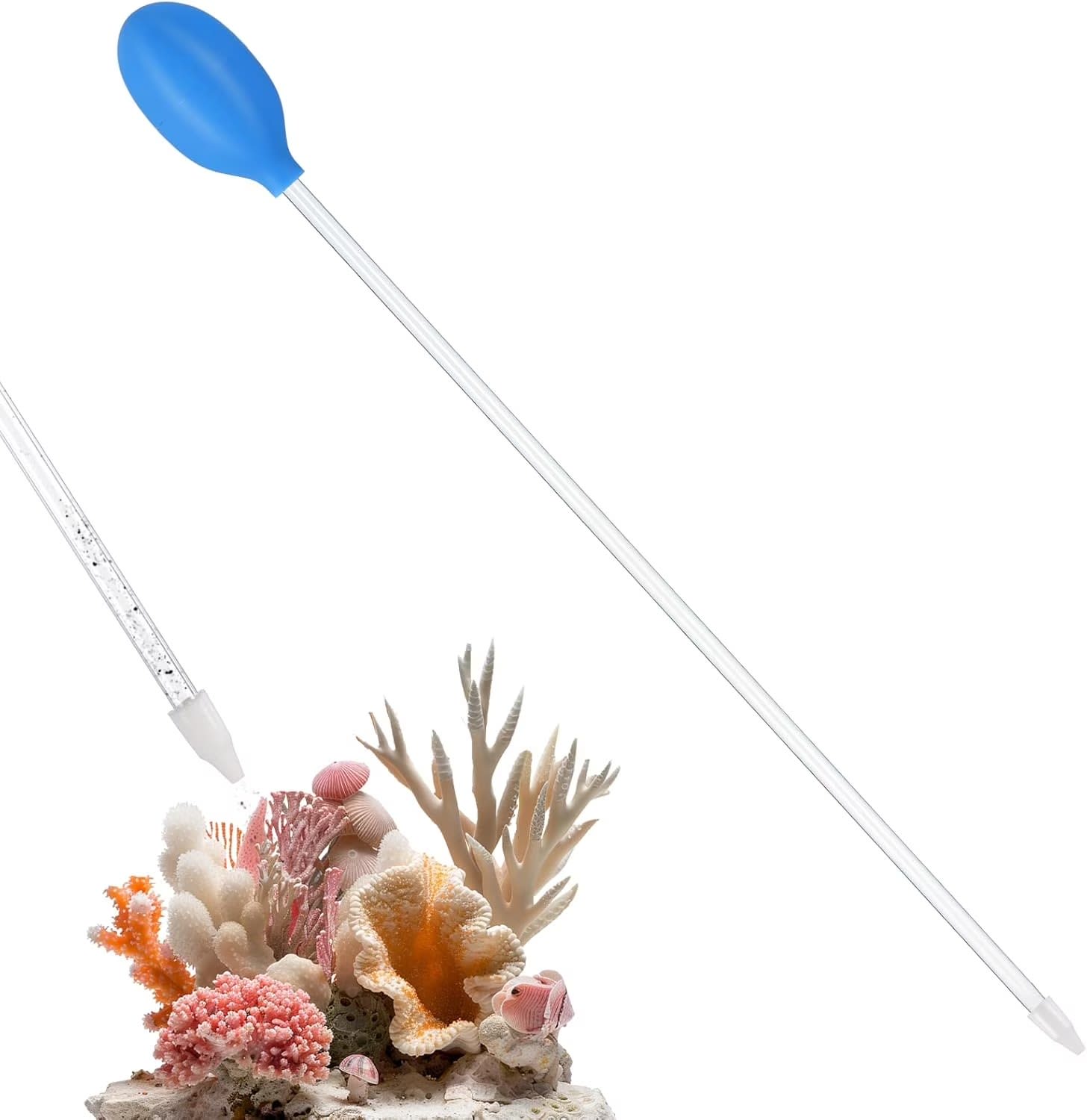
Representative photo. The product you buy may differ in size, colour or packaging.
Long pipette
accessory
Used for: Tank maintenance
Description
A long aquarium feeding pipette places food at a chosen spot and can direct water over decorations during cleaning. Aquarium versions include small transfer pipettes and larger bulb-and-tube feeders. Select the opening for the food you intend to deliver; the ARKA aquarium pipettes cited here are intended for ornamental-fish feeding, including larger food particles, as well as rinsing decorations. Choose reach and filling capacity separately. A longer tool needs to reach the feeding or cleaning point, while its capacity determines how much liquid it can hold per filling. For example, the ARKA Multifunction-Pipette is 30 cm long with a 50 ml filling volume and includes a cleaning brush; its Universal-Pipette range offers 3 ml and 10 ml versions. These are model-specific sizes, not a standard length or volume for all aquarium pipettes. For feeding and rinsing, select the form and capacity that suit the task. A stated filling volume does not by itself give a measurement-error limit. These product pages do not publish a numerical dosing tolerance, so their feeding and capacity specifications should not be treated as evidence of calibrated laboratory accuracy.
Sources
- arka-biotech.de — https://www.arka-biotech.de/en/products/multifunction-pipette
- arka-biotech.de — https://www.arka-biotech.de/en/products/universal-pipette/fuellvolumen-3-ml-fpipe3
Further reading on identification and aquarium care.
Was this page useful? Spot anything wrong?