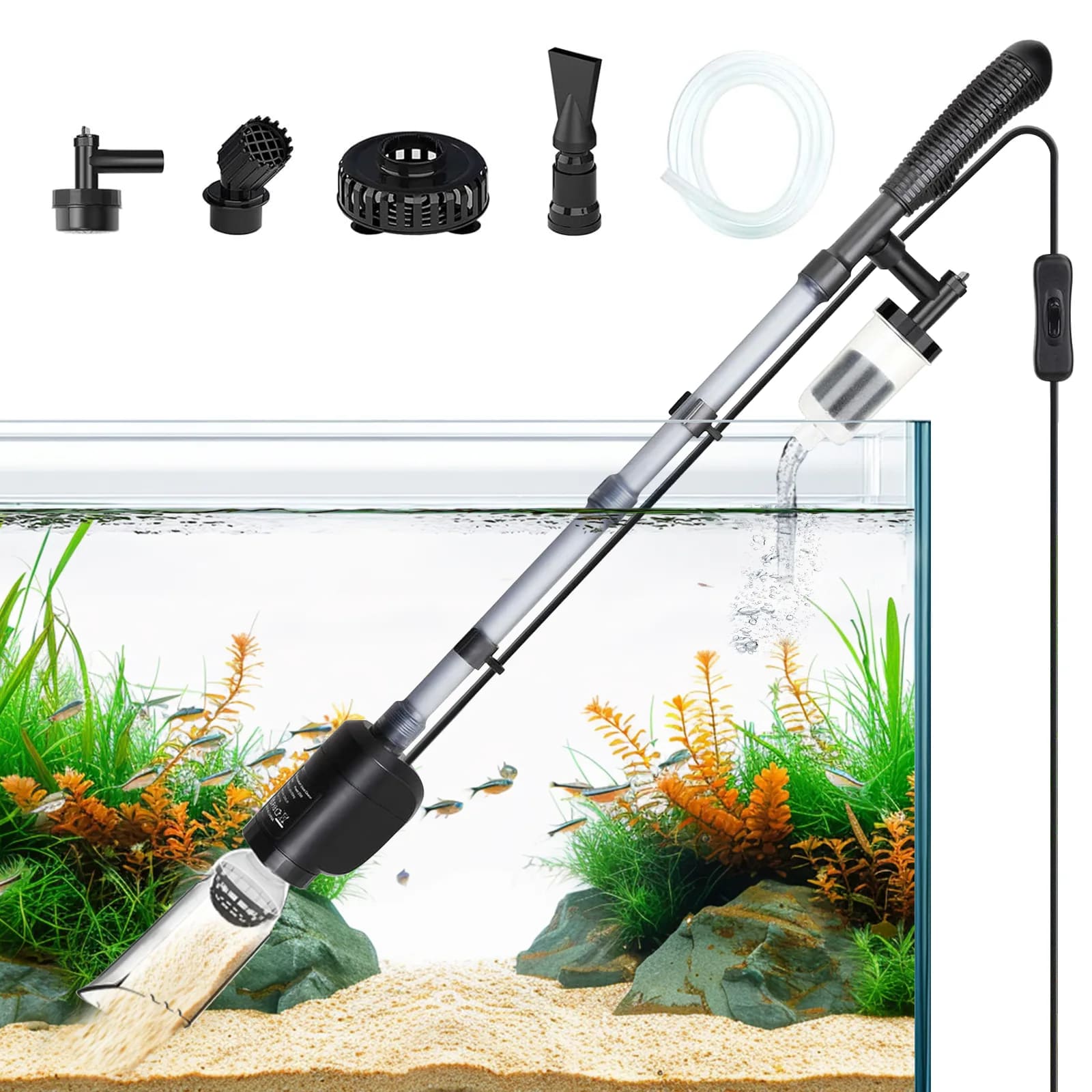
Representative photo. The product you buy may differ in size, colour or packaging.
Gravel vacuum
accessory
Used for: Tank maintenance
Description
A gravel vacuum removes loose dirt and debris from aquarium substrate. A siphon model combines a rigid intake tube with a flexible hose, carrying dirty water out to a bucket during a water change. Common starting arrangements include a squeeze bulb or a valve activated by moving the intake. Flow controls and hose clips help manage the discharge while cleaning. Powered cleaners serve a different maintenance pattern. A battery-operated unit with a debris compartment can collect dirt and return the water to the aquarium, allowing spot cleaning between water changes. The EHEIM Quick Vacpro uses this arrangement. Choose a siphon for removing water as well as debris; choose a recirculating cleaner when the immediate task is debris collection. Returning filtered water does not perform a water change. Match the cleaner to the substrate before choosing its size. Sand compatibility is model-specific: Fluval GravelVAC lists sand among its supported substrates, while Quick Vacpro instructions exclude sandy bottoms. Planted soil can need a different technique. For Fluval Stratum, hover a small gravel vacuum above the soil and gently lift surface debris rather than working the tube through the granules. Check that the intake or extension reaches the area to be cleaned and that the hose reaches the collection container. An intake shaped for corners helps in confined spaces; a flow regulator or shutoff tap provides control over the water being removed. Inspect and clean removable intake screens and debris compartments. Keep quarantine siphons separate from equipment used in the display aquarium.
Sources
- jbl.de — https://www.jbl.de/?country=de&func=detail&id=25155596&lang=de&mod=productsv2
- fluvalaquatics.com — https://fluvalaquatics.com/uk/shop/product/gravelvac-multi-substrate-cleaner-s-m-up-to-20-50-8-cm
- eheim.com — https://eheim.com/en_GB/aquatics/accessories/cleaning/automatic-gravel-cleaner/quick-vacpro?c=1941
- eheim.com — https://eheim.com/media/41/a3/ae/1766016442/3531_QuickVac_01.21.pdf
- fluvalaquatics.com — https://fluvalaquatics.com/us/faqs/stratum-series
- merckvetmanual.com — https://www.merckvetmanual.com/exotic-and-laboratory-animals/aquarium-fish/management-of-aquarium-fish
Further reading on identification and aquarium care.
Was this page useful? Spot anything wrong?