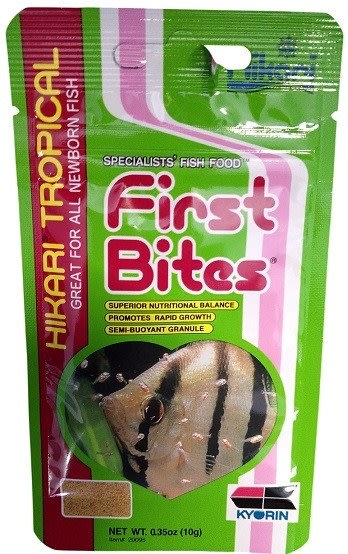
Representative photo. The product you buy may differ in size, colour or packaging.
Fry powder food
food
Used for: Breeding tanks, Tank maintenance
Description
Prepared fry food supplies fine particles for young fish that cannot take ordinary adult-sized food. Choose for the species, developmental stage and mouth size. A fine prepared food is one option; its suitability does not establish that every newly hatched fish will accept it instead of live food. Check how the food behaves in water. Hikari First Bites is a semi-floating example, and its instructions describe soaking a portion in aquarium water to make it sink faster for mid-water and bottom-feeding fry. Powder size and sinking behaviour are features of the selected product. The point at which feeding begins also matters. Hikari distinguishes live-bearing fry that can eat after birth from egg-layer fry initially supported by a yolk sac. Follow guidance for the actual species and stage, and watch whether the fry can reach and consume the particles. Offer portions suited to the fry and avoid accumulating uneaten food. Check the product instructions rather than adopting a universal body-weight percentage or feeding timer. Keep the package as its label directs and check the best-before date. Feeding access, acceptance and cleanliness matter alongside the food formulation.
Sources
- hikari.info — https://www.hikari.info/tropical/t_13.html
- hikariusa.com — https://www.hikariusa.com/faq.html
Further reading on identification and aquarium care.
Was this page useful? Spot anything wrong?