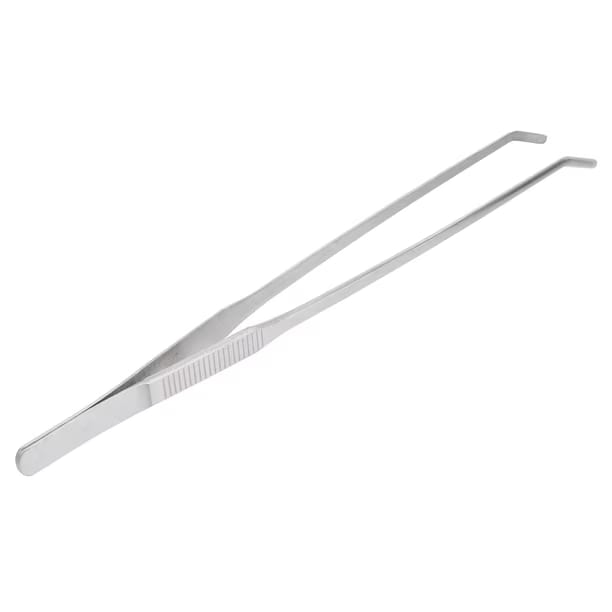
Representative photo. The product you buy may differ in size, colour or packaging.
Curved tweezers
accessory
Used for: Aquascaping, Planted tanks, Tank maintenance
Specifications
| Specification | Value |
|---|---|
| Length | 24 Inch |
| Material | Stainless Steel |
Source checked on 2026-10-02.
| Specification | Value |
|---|---|
| Length | 10.6" |
| Material | Stainless Steel |
Source checked on 2026-10-02.
| Specification | Value |
|---|---|
| Length | 10.5inch |
| Material | Stainless Steel |
Source checked on 2026-10-02.
| Specification | Value |
|---|---|
| Length | 10.6" |
| Material | Stainless Steel |
Source checked on 2026-10-02.
Description
Curved aquarium tweezers hold aquatic plants while you place them in the substrate. Their bent tips provide an angled approach to the planting point, useful when working around stones, driftwood or existing plants. A curved pair can suit inserting a small group of plants, while straight tweezers offer a direct approach for individual planting. Choose the length for the planting position and the space available around it. Check how the tips meet and how much pressure is needed to close the handles: length, tip alignment and spring resistance all affect control. Fine tips and wider gripping tips provide different ways to hold plants; wider grip designs are available for plants such as Cryptocoryne and Echinodorus. Curved tweezers are sold individually and in kits alongside straight tweezers, scissors and substrate tools. Compare the length of the curved pair itself with the reach you need. Kit dimensions, another tool’s length and serrated-tip features belong to their specific products; the curved shape alone does not establish any of them. Rinse and dry stainless aquascaping tweezers after use. Freshwater as well as seawater can leave salts on the metal, and corrosion resistance still depends on care.
Sources
- jbl.de — https://www.jbl.de/cs/blog/detail/279/jbl-proscape-tools?country=cz
- jbl.de — https://www.jbl.de/?country=gb&func=detail&id=25183217&lang=en&mod=productsv2
- adana.co.jp — https://www.adana.co.jp/en/contents/products/na_layout/detail02.html
Further reading on identification and aquarium care.
Was this page useful? Spot anything wrong?