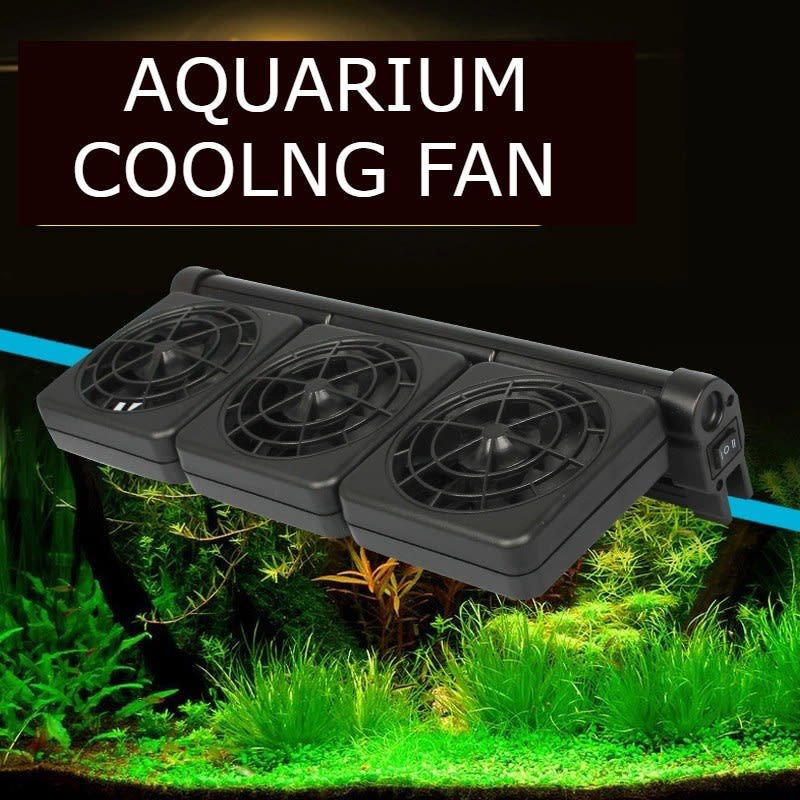
Representative photo. The product you buy may differ in size, colour or packaging.
Cooling fan
heater
Used for: Tank maintenance
Specifications
| Specification | Value |
|---|---|
| Control | Two speeds |
Source checked on 2026-10-02.
| Specification | Value |
|---|---|
| Control | Two speeds |
Source checked on 2026-10-02.
Description
An aquarium cooling fan moves air across the water surface to promote evaporation and remove heat. Its effect depends on the surrounding air and the aquarium conditions. High humidity weakens evaporative cooling, so a fixed temperature reduction is not a dependable specification for every installation. Allow for the extra water loss and replenish evaporated water regularly. Common aquarium designs include rows of small axial fans and cross-flow units that produce a broad stream of air. Before choosing one, check the clamp opening, tank-edge thickness, space for the housing and whether the air can reach the exposed water surface. The two-fan LONDAFISH and DaToo examples below each specify a maximum rim thickness of 12 mm. That is a mounting limit, not a measure of cooling capacity; fan count alone also does not establish the temperature a tank will reach. Choose the control arrangement as well as the physical size. Some units have manual speed settings, while others use a water-temperature sensor or a compatible separate controller. The two listed two-fan products have two speed settings; this does not make them thermostatically controlled. Aim the airflow as the selected model instructs and account for any lid obstructing it. If a cover is opened for airflow, retain suitable protection against fish jumping. Keep the fan and electrical connections out of the water and follow the product instructions for splash exposure.
Sources
- spectrumbrands.jp — https://spectrumbrands.jp/products-aqua/heater/75076/
- jbl.de — https://www.jbl.de/en-dk/productsv2/detail/25210102
- amazon.com — https://www.amazon.com/dp/B07FCJGZ4H
- amazon.com — https://www.amazon.com/dp/B085LM313D
Further reading on identification and aquarium care.
Was this page useful? Spot anything wrong?