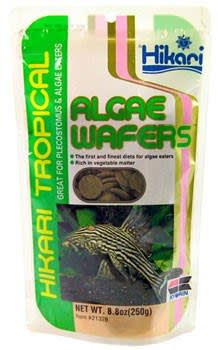
Representative photo. The product you buy may differ in size, colour or packaging.
Algae wafer
food
Used for: Tank maintenance
Description
Algae wafers are prepared sinking food pieces for fish that graze near the bottom. Hikari Algae Wafers is a disc-shaped example developed for plecostomus and other algae-eating bottom feeders. Choose for the fish’s diet; living near the substrate does not itself make a fish an algae eater. Check the formulation as well as the shape. Hikari’s wafers include vegetable matter alongside animal-derived ingredients. An algae name does not mean the food consists only of algae, or that it supplies the right diet for every pleco or bottom-feeding species. The sinking form gives fish access below the surface. Check the size and texture of the selected wafer and whether the fish can feed on it. Diameter, formula and feeding duration vary by product; do not use one brand’s disc size as a definition of the category. Offer food when the intended fish are active and able to reach it. Hikari notes that some bottom feeders are nocturnal and advises removing uneaten food. Follow the actual product’s portion and storage instructions, and watch consumption instead of treating a wafer as an unattended, unlimited food source.
Sources
- hikariusa.com — https://hikariusa.com/tropical_folder/algae_wafers.html
- hikariusa.com — https://www.hikariusa.com/faq.html
Further reading on identification and aquarium care.
Was this page useful? Spot anything wrong?