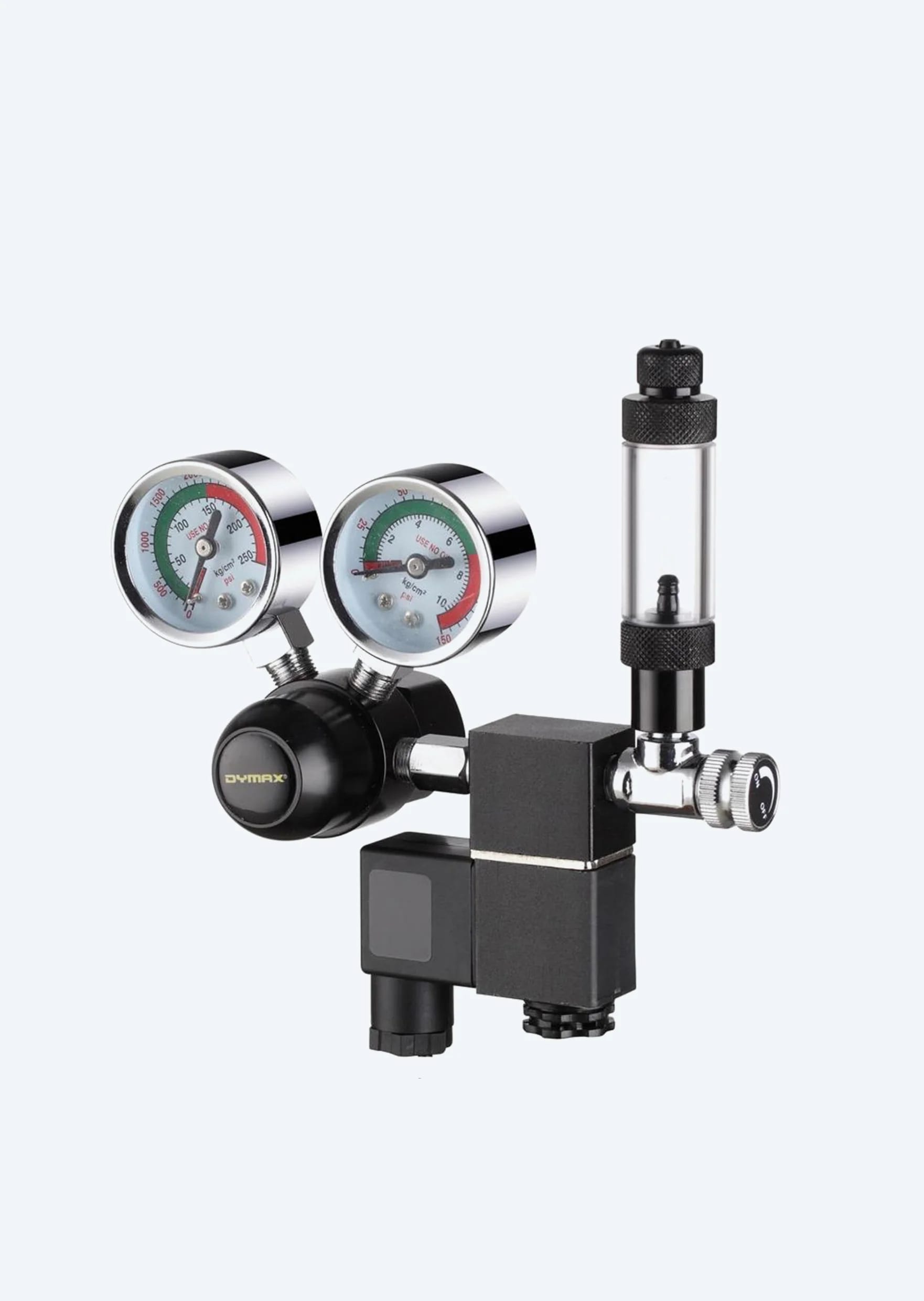
Representative photo. The product you buy may differ in size, colour or packaging.
CO₂ Regulator with Solenoid
CO2Art Pro-SE Regulator
co2
Used for: Planted tanks, CO2 injection
Specifications
| Specification | Value |
|---|---|
| Stages | Dual stage |
| Solenoid | Integrated 12 V DC solenoid valve |
| Working pressure | Up to about 3 bar (40 psi) |
| Cylinder thread | Alternative variants: BS341 / DIN477 / W21.8 or CGA320; match cylinder valve |
Source checked on 2026-10-01.
Description
The CO2Art PRO-SE is a dual-stage regulator for aquarium CO2 injection. It reduces cylinder pressure to an adjustable working pressure; CO2Art describes its two-stage design as stabilising the outlet as cylinder pressure falls. It includes separate cylinder-pressure and working-pressure gauges, a fine-adjustment needle valve, and a bubble counter with a built-in check valve. The integrated solenoid operates at 12 V DC from the supplied 100-240 V power adapter. The specified working-pressure adjustment reaches about 3 bar (40 psi). Match the operating requirement of the intended diffuser and other downstream components to that range; this figure does not establish compatibility with every diffuser. Order the cylinder connection that matches the cylinder valve. The listed alternatives are BS341 / DIN477 / W21.8 and CGA320; these are different purchase options, not interchangeable fittings on one regulator. Cylinder capacity alone does not determine whether it fits. Confirm the connector on the actual cylinder and selected regulator variant before ordering.
Source
Further reading on identification and aquarium care.
Was this page useful? Spot anything wrong?