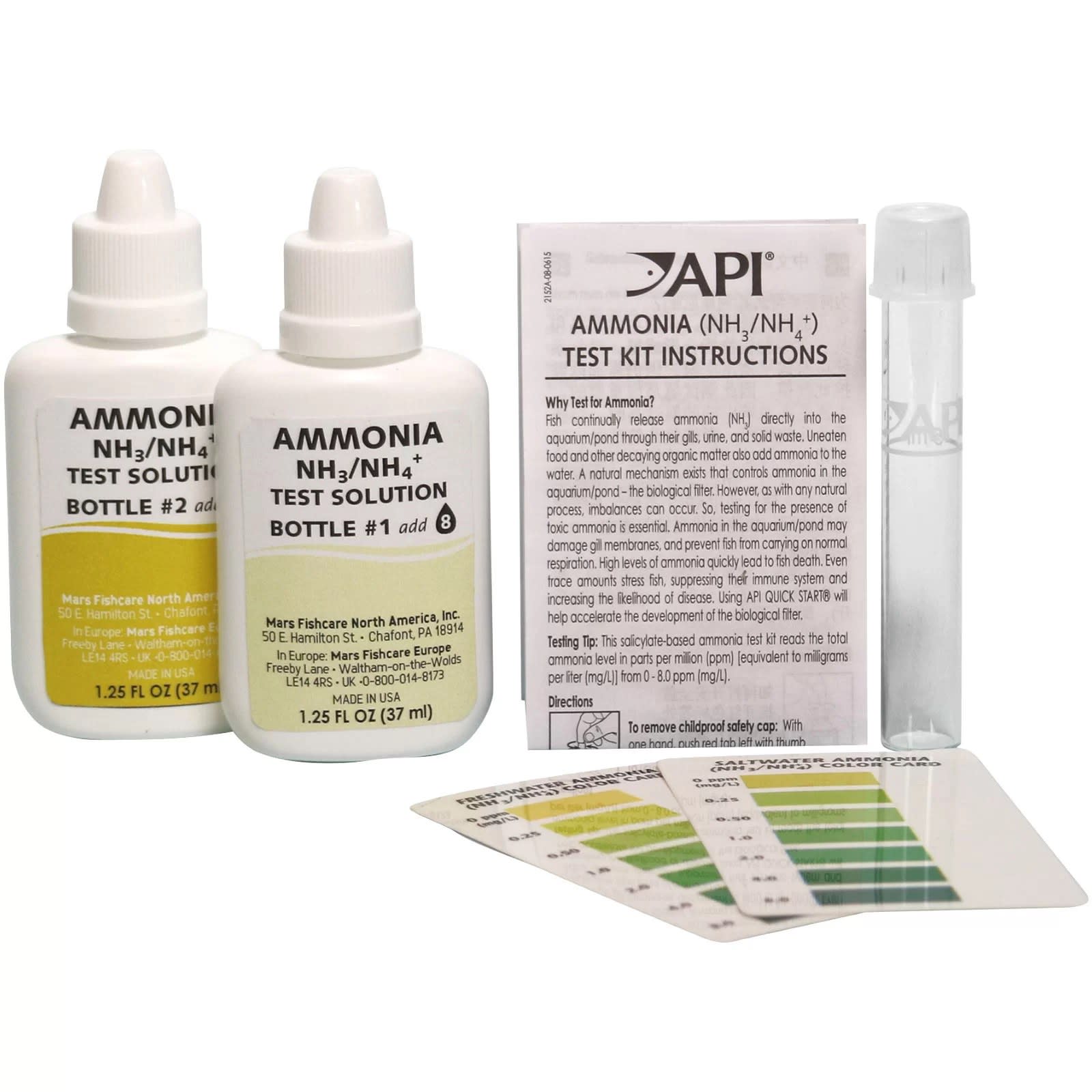
Representative photo. The product you buy may differ in size, colour or packaging.
Freshwater Master Test Kit
API Freshwater Master Test Kit
accessory
Used for: Water testing, Tank maintenance
Specifications
| Specification | Value |
|---|---|
| Measures | pH, high range pH, ammonia, nitrite, and nitrate |
| Form | Test tubes with test drops compared to a color card |
| Calibration | Computer calibrated, laminated color card |
Source checked on 2026-10-02.
Description
The API Freshwater Master Test Kit is a liquid-reagent kit for checking pH, high-range pH, ammonia, nitrite and nitrate in freshwater aquariums. It suits monitoring a new aquarium and routine water-quality checks. The two pH tests cover different ranges of the same measurement. The kit includes seven test solutions, four test tubes, a holding tray and a laminated color card that API describes as computer calibrated. Testing uses a measured water sample, the appropriate reagents and comparison with the matching color chart. This is a visual color-comparison kit. Follow the individual instructions for each test: sample volume, bottle preparation, mixing and development time differ. Shake the reagent bottles specified by the instructions, keep the tube capped while mixing, and rinse it with water immediately after reading. Choose this kit when its listed tests cover your freshwater monitoring needs. GH, KH and phosphate are outside that coverage and require separate tests. A clear-looking aquarium can still have a water-quality problem, so judge it using the measured results and the requirements of its inhabitants.
Sources
- apifishcare.com — https://www.apifishcare.com/products/api-freshwater-master-test-kit
- images.salsify.com — https://images.salsify.com/image/upload/s--UyvqZ_5t--/f4e3e9bf7c2ee9d9bd4a27e4d35eda7e3b77b9b4.pdf
- images.salsify.com — https://images.salsify.com/image/upload/s--EmRTFyQD--/ea0e7833d83f430d009e83c2f6786f3300307bf3.pdf
- apifishcare.com — https://www.apifishcare.com/products/api-general-carbonate-hardness-test-kit
- apifishcare.com — https://www.apifishcare.com/products/api-phosphate-test-kit
Further reading on identification and aquarium care.
Where to buy
We recommend verified sellers and official distributors.
API Freshwater Master Test Kit (800 tests)
Was this page useful? Spot anything wrong?